

warehouse insider
Creating an accurate, traceable return event at the first critical control point in reverse logistics
The core challenge
RMA operations receive unlike parcels with inconsistent labels, uncertain identity, and varying amounts of expected data. Manual check-in requires operators to find the right code, open records, compare fields, and decide where each return goes. As volume and product value rise, that process becomes slow, difficult to audit, and vulnerable to costly association errors.
A return may arrive with a carrier label, RMA number, customer reference, product identifier, serial number, internal asset tag, or several obsolete labels. The authoritative value may be on a different face from parcel to parcel, and the expected record may require more than a successful barcode read. The operation needs to establish that the physical package belongs to the intended return transaction.
Vimaan ParcelSCAN digitizes each return as a parcel event, extracts configured exterior identifiers, and supports comparison with the expected RMA or asset record. Images, selected fields, match status, dimensions, and exceptions remain associated with the physical parcel so the validated return can enter the next process with traceable evidence.
What This Application Addresses
Why a Return Label Read Is Not Yet a Validated Receipt
The return transaction begins with parcel identity, but the identifier used by the carrier, customer, service organization, and internal system may not be the same. Three linked failure points make manual RMA intake difficult to scale.
1. The authoritative identity is not obvious.
A package may display current and obsolete shipping labels, multiple serial-like values, supplier codes, and customer references. Reading the first available barcode can create a confident but incorrect association.
2. Parcel receipt must be compared with transaction context.
The workflow may need to confirm that the RMA is open, the item or serial is expected, the parcel has not already been received, and required exterior fields are present. Those decisions depend on expected data and rules from the surrounding business system.
3. Downstream work depends on the intake association.
Triage, repair, restock, vendor return, credit, disposal, and outbound release all depend on the correct physical item remaining associated with the correct RMA. An error at receiving is expensive to reconstruct after the parcel has moved.
The useful outcome is a trusted return event
The control point is not a list of decoded values. It is a defensible association among the physical parcel, the selected identity, the expected RMA or asset record, the validation result, and the next handoff.
Common operational consequences
From Physical Return to Validated System Handoff
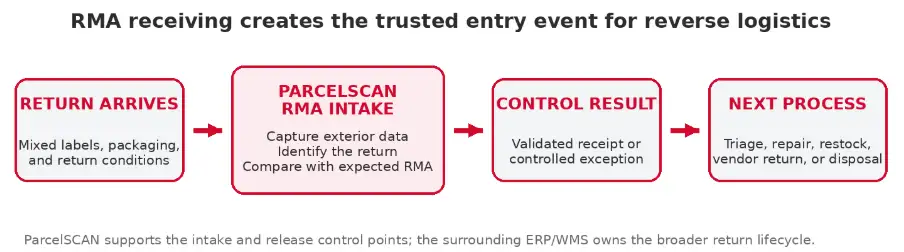
ParcelSCAN supports the return intake sequence while the ERP, WMS, service platform, or return-management system retains ownership of eligibility, disposition, inventory, financial, and customer-service logic.
| Step | Control | What happens |
| 1 | Load | Open the expected RMA, return authorization, order, or asset record. |
| 2 | Induct | Present each parcel individually at a conveyor or controlled workstation. |
| 3 | Capture | Image configured exterior faces and collect barcode, OCR, and optional RFID data. |
| 4 | Identify | Select the authoritative RMA, tracking, item, serial, or internal identifier. |
| 5 | Compare | Match the parcel event with the expected return and required validation fields. |
| 6 | Classify | Confirm receipt or assign a reasoned exception without forcing an uncertain match. |
| 7 | Direct | Send the parcel to the defined triage, repair, restock, vendor, or review process. |
| 8 | Record | Preserve images, extracted data, match status, timing, and final handoff. |
RMA automation within reverse logistics
Reverse logistics can include return authorization, transportation, receiving, inspection, testing, repair, refurbishment, restock, vendor return, resale, recycling, disposal, customer credit, and outbound shipment. ParcelSCAN should not be positioned as the system that manages this complete lifecycle.
Its strongest role is narrower and operationally critical: create a reliable digital record when the return enters the facility and, when required, verify the parcel again when it leaves a controlled process. This gives the broader reverse-logistics workflow a trustworthy physical-to-digital handoff without moving customer-specific lifecycle logic into the vision platform.
Condition and contents boundary
Exterior images can document packaging condition and visible damage. They do not prove the condition, quantity, serial number, or contents of a sealed package unless that information is externally visible, provided through a trusted association, or available from a proven RFID read.
What ParcelSCAN Contributes to RMA Processing
Selecting the right identifier
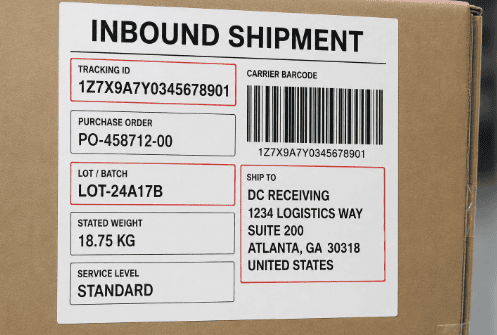
Rules may vary by customer, product family, service program, and return channel. They should define which field is authoritative, how carrier or customer identifiers map to internal records, which values must be unique, and what evidence is required before the parcel can be posted automatically.
For example, a carrier tracking number may locate the shipment record while the RMA number identifies the return transaction and a serial number identifies the asset. ParcelSCAN can collect these visible values as one event; the integrated workflow determines which relationships must be confirmed.
Integration and ownership boundaries
| Scope boundary | Production meaning |
| ParcelSCAN can validate | Exterior RMA and carrier labels; visible barcodes and text; configured identifier relationships; parcel dimensions; optional RFID reads; receipt and release evidence. |
| Surrounding systems typically own | RMA creation and eligibility; refund or credit logic; disposition authorization; repair workflow; inventory status; customer communication; financial posting. |
| A controlled exception is still required when | The necessary serial, quantity, part, ownership, or condition information is inside a sealed carton and no trusted external or RFID association exists. |
Exception handling is part of the RMA workflow
| Exception | Controlled response |
| No readable return identifier | Retain the parcel images, retry configured views, or route to review without assigning an uncertain RMA. |
| Multiple candidate identifiers | Apply label-of-interest rules; if ambiguity remains, present candidates and hold the event for confirmation. |
| RMA not found or closed | Keep the parcel in an unmatched queue and follow the customer-specific unauthorized-return process. |
| Item or serial not expected | Prevent automatic posting and direct the parcel to the defined wrong-item or ownership review. |
| Repeated unique identifier | Flag the second receipt when an RMA, serial, tracking, or asset identifier should occur only once. |
| Required exterior field missing | Hold the event for a supplemental lookup, relabel, or controlled open-carton process. |
| Visible package damage | Preserve exterior evidence and route to the customer-defined inspection process; do not infer internal condition. |
| System or interface unavailable | Queue the parcel event with its evidence and prevent unconfirmed posting until recovery rules are satisfied. |
Accelerating High-Value Check-In and Check-Out
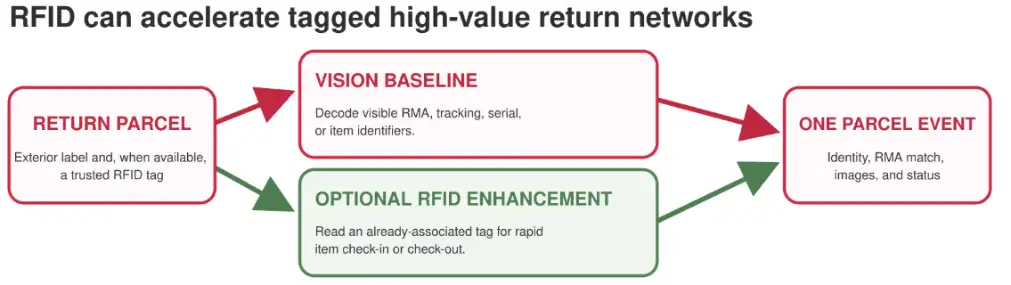
RFID is not required for most RMA workflows. Exterior vision remains the baseline because every parcel can present a visible label while only selected networks have a reliable RFID tag standard and item association. RFID becomes valuable when a high-value asset is already tagged and the same identifier is trusted across the customer, service, repair, and return network.
In that environment, a configured read can reduce the repeated manual process of finding and scanning a serial or asset label at each handoff. The RFID value can be reconciled with the visible parcel identity and expected RMA during receiving, then checked again when the asset or parcel leaves repair, staging, or shipping.
What must be proven for RFID
RFID strengthens an association; it does not create one
A fast read is useful only when the tag-to-item mapping and transaction relationship are trusted. Otherwise, RFID can accelerate the wrong decision just as easily as a misapplied barcode.
Proving the RMA Rules Before Scaling Volume
A production test should include representative customers, product families, label templates, package sizes, multiple-label cases, worn labels, closed and expired RMAs, duplicate parcels, unexpected serials, and the open-carton exceptions that remain outside exterior automation. RFID testing should be a separate workstream using the final tags, products, packaging, spacing, and reader geometry.
Rules to define before production
Expected operational value
RMA processing is a natural ParcelSCAN application because it begins with a recurring physical-to-digital control problem: determine what arrived, connect it to the correct expected return, and preserve enough evidence to move it forward confidently. That validated intake event can support the broader reverse-logistics process without claiming ownership of inspection, disposition, repair, credit, or inventory logic.
ParcelSCAN provides the exterior imaging, data capture, label selection, comparison-ready event, and exception record needed to make RMA receiving repeatable. RFID can extend that workflow for tagged high-value assets, but only where item association, tag performance, packaging, and read-zone control have been proven.
Q1. What does ParcelSCAN automate in an RMA process?
ParcelSCAN captures configured exterior parcel faces, decodes visible barcode and text fields, selects the relevant identifier, and creates a parcel event that can be compared with the expected RMA or asset record. It also preserves images, selected data, match status, dimensions, and exceptions for traceability.
Q2. Does ParcelSCAN manage the complete reverse-logistics lifecycle?
No. It supports the physical intake and, when configured, release validation points. The surrounding return-management, ERP, WMS, service, or repair systems normally own authorization, disposition, inspection, inventory status, credit, customer communication, and financial posting.
Q3. Can ParcelSCAN validate a sealed returned item?
It can validate the exterior label and any trusted data associated with that parcel. If the required item, serial, quantity, ownership, or condition information exists only inside the carton, the operation still needs an open-carton inspection or another trusted association such as a proven RFID tag.
Q4. When does RFID improve RMA receiving?
RFID is most useful when higher-value items are already tagged, the tag is uniquely mapped to the asset, and the identifier is trusted across the return network. It can accelerate repeated check-in and check-out while visible labels and images provide parcel context and evidence.
Q5. Can RFID read through every return package?
No. Read performance depends on tag type and placement, item materials, packaging, orientation, distance, nearby tags, and reader geometry. Metal and metallized ESD packaging can be especially challenging, so the production tag and package combinations must be tested.