

warehouse insider
Sustaining reliable six-sided capture, routing decisions, and exception control at production conveyor speed.
The core challenge
High-volume parcel networks must identify and route a wide range of packages without slowing the conveyor. At thousands of parcels per hour, even a small no-read, false-match, or late-decision rate can create a large manual exception burden and send errors downstream.
Parcel sortation environments combine high throughput with extreme variation. Boxes, polybags, padded mailers, tubes, and irregular packages may enter the same line with labels placed on any surface, printed at different quality levels, or surrounded by unrelated barcodes and markings. The automation must maintain parcel identity from induction through the sorter while the decision window continues to shrink with line speed.
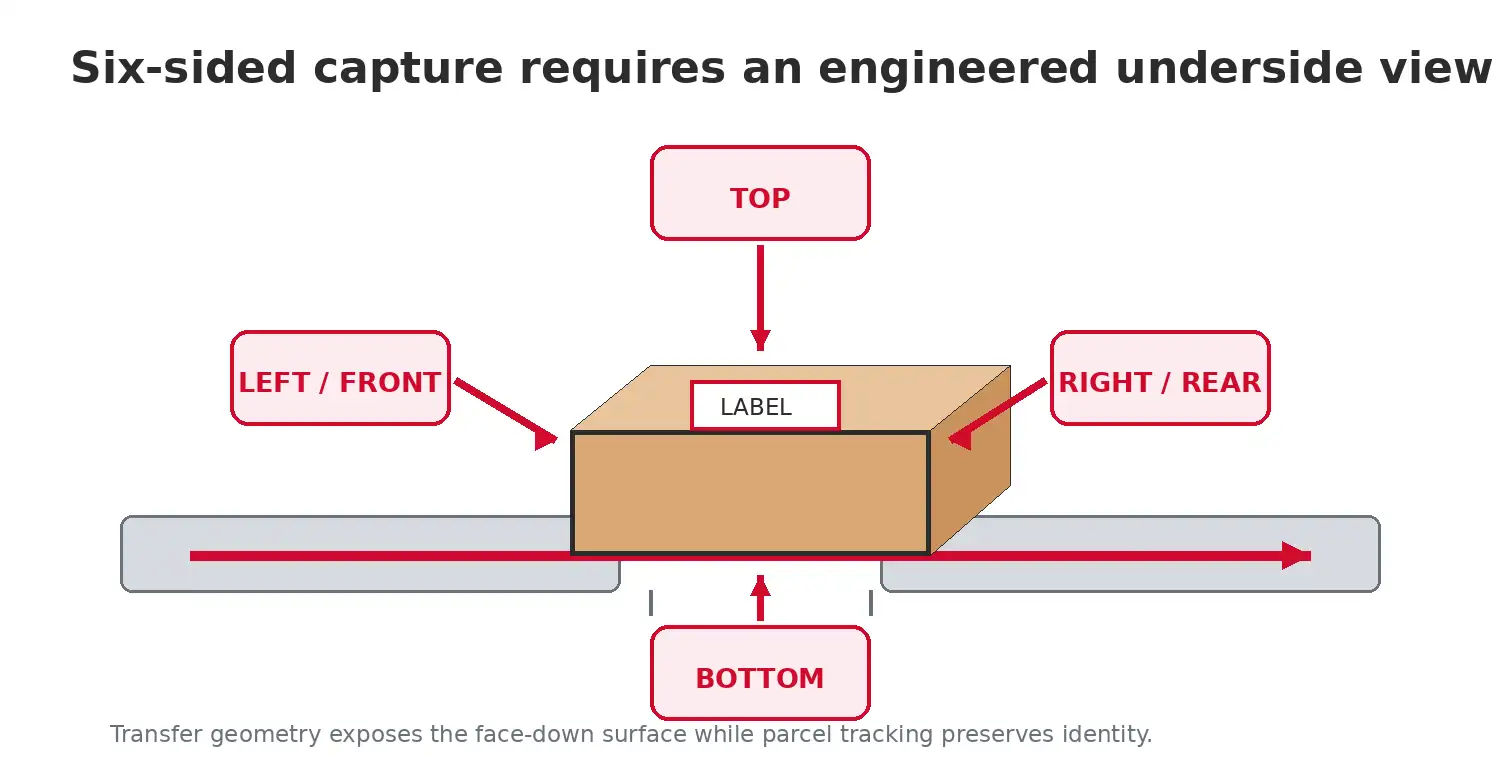
Vimaan’s ParcelSCAN creates a tracked digital event for each parcel, captures configured exterior faces, extracts the relevant barcode or text, and delivers the data needed to make a route decision. When labels may appear on the face resting on the conveyor, the production design can add an engineered transfer and underside imaging station so the bottom surface becomes visible without breaking parcel association.
What This Application Addresses
Why Scan Rate Alone Does Not Prove Sortation Performance
A high-speed tunnel can acquire many images, but the operation succeeds only when the correct parcel identity is available early enough to execute the correct divert. Three linked conditions determine that outcome.
Three linked failure points
1. The decisive label may be on any face.
Top and side coverage can still miss the only useful identifier when it is face down. If the process cannot control label placement upstream, complete coverage requires a deliberate method for exposing and imaging the underside.
2. A decoded value must remain attached to the correct parcel.
Closely spaced or unstable parcels can create trigger errors, merged events, or data-to-package mismatches. Gapping, sensing, position tracking, and transfer behavior must work as one system, especially when capture occurs at multiple physical points.
3. The decision must arrive before the sorter needs it.
Image acquisition is only the first step. Decoding, label selection, record lookup, route assignment, communication, and the physical divert all consume time. The architecture must be validated against the shortest production decision window at peak load.
Throughput means parcels correctly routed
The useful rate is not images captured or codes attempted. It is the sustained number of parcels correctly identified, assigned, and physically delivered to the intended destination with exceptions kept under operational control.
Common operational consequences
One Parcel Event from Induction Through Divert
The operating sequence must preserve identity across cameras, conveyor transfers, software decisions, and sorter actions. Ownership varies by deployment, but the handoffs and timing budget should be explicit before production.
| Step | Control | What happens |
| 1 | Singulate | Maintain defined parcel gaps and stable presentation at lane speed. |
| 2 | Track | Create one parcel event and preserve its position through every capture point. |
| 3 | Capture | Image the top, four vertical faces, and the exposed underside. |
| 4 | Identify | Decode configured 1D/2D codes and text; select the label of interest. |
| 5 | Normalize | Convert the selected identity into the format used by the routing system. |
| 6 | Decide | Match the parcel to a route while it remains inside the sorter decision window. |
| 7 | Act | Commit the destination or divert an uncertain event to a controlled exception path. |
| 8 | Record | Retain images, extracted data, route result, timing, and exception history. |
Engineering the sixth face
Top and four vertical surfaces can be captured around a conventional tunnel. The face resting on the belt requires a different mechanical view. A production six-sided configuration typically uses an engineered transfer – such as a split, narrow-belt, or other suitable conveyor arrangement – that briefly exposes the underside to dedicated cameras and lighting while the control system continues to track the parcel.
Application-specific conveyor design
The transfer and camera arrangement must be selected for the actual parcel size and weight range, package stability, required gap, belt speed, available footprint, and maintenance access. Six-sided coverage is an engineered production configuration, not a camera-only add-on.
What ParcelSCAN Contributes at High Speed
From capture to route commitment
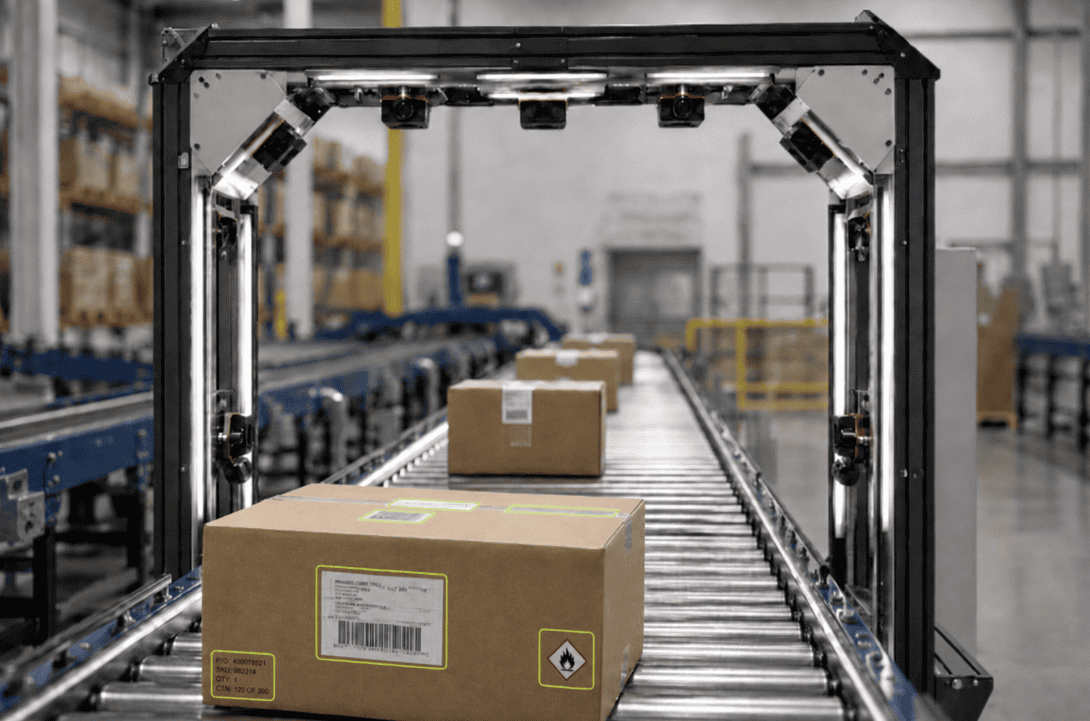
The identity pipeline may decode several candidates from multiple views. Configured rules select and normalize the intended field, after which the parcel is matched to a route record. The result must include a definitive destination or a defined exception state; an uncertain match should never be converted silently into an automatic sort decision.

Integration and ownership boundaries
ParcelSCAN can provide the vision, decoding, label-selection, and parcel-event layer. The WCS, WES, warehouse application, PLC, sorter controller, or integrator may own route lookup, conveyor tracking, divert commands, physical sorter execution, recirculation, and lane-full logic.
The integrated design should document ownership and define parcel IDs, position signals, route messages, acknowledgements, timeouts, fail-safe destinations, clock alignment, retry rules, and the treatment of late or duplicate messages.
Exception handling is part of line capacity
| Exception | Controlled response |
| No readable routing identifier | Use the available views and configured retry logic; otherwise divert without inventing an identity. |
| Multiple plausible identifiers | Apply label-of-interest rules and confidence thresholds; hold unresolved events for review. |
| No route match | Send the parcel to the defined unmatched path and retain its images and candidate data. |
| Merged or ungapped parcels | Block the combined event from automatic routing and recirculate or separate the parcels. |
| Underside not exposed | Treat six-sided coverage as incomplete; route according to the configured retry or manual process. |
| Parcel is Damaged | Automatically or manually divert package to hospital |
| Parcel is Oversized | Automatically or manually route those parcels separately |
| Parcel unstable at transfer | Protect parcel tracking, stop or divert if required, and classify the mechanical cause for correction. |
| Late decision or communication failure | Use the predetermined fail-safe route rather than allowing an unconfirmed divert. |
| Divert confirmation failure | Record the control fault and reconcile the physical parcel before returning it to the automated stream. |
| Recirculation limit reached | Move the parcel to staffed resolution so it cannot consume line capacity indefinitely. |
Exception capacity must scale with peak volume
A low percentage can still represent hundreds of parcels during a peak period. The exception spur, recirculation loop, accumulation, staffing, and resolution tools must be sized as part of the production system, not added after commissioning.
Proving the Complete Operating Envelope
Commissioning should progress from capture observation to shadow route decisions and then controlled automatic diversion. The test set should represent the production parcel mix rather than ideal cartons: smallest and largest packages, dark and reflective materials, polybags, worn labels, labels near edges or seams, multiple codes, skewed presentation, tight legal gaps, and peak arrival patterns.
Design inputs to establish before detailed engineering
Production acceptance metrics
A common ParcelSCAN hardware configuration can support multiple workflows when parcel size, speed, capture coverage, and scheduling are compatible. Dedicated receiving and shipping lanes may still be preferred for concurrency, redundancy, or different peripheral equipment. These are operational design choices rather than separate vision platforms.
| Production metric | What it proves |
| Sustained throughput | Parcels processed per hour across representative volume and package mix. |
| Correct identification rate | Parcels assigned to the intended identity without manual correction. |
| Correct route rate | Parcels delivered to the intended destination, including sorter execution. |
| No-read / ambiguity rate | Events requiring retry, recirculation, or operator resolution. |
| Decision latency | Time from parcel trigger to route commitment at peak processing load. |
| Manual touches | Operator interventions per 1,000 parcels, classified by cause. |
Expected operational value
Very high-volume sortation is an end-to-end control problem. The operation must see the relevant label, preserve the physical parcel association, select the right identity, obtain a route, and execute the divert before the decision window closes. Weakness at any point turns speed into recirculation, manual handling, or missorts.
ParcelSCAN provides the multi-camera capture, data extraction, label-selection, and traceability layer for this workflow. When it is combined with engineered six-sided conveyor coverage, reliable tracking, defined integration ownership, and production-scale exception handling, high parcel volume can be processed with the efficiency and accuracy the network requires.
Q1. Why would an operation require six-sided parcel scanning?
Six-sided coverage is appropriate when the authoritative label may appear on any exterior face and upstream label orientation cannot be controlled. Capturing only the top and sides leaves a known blind surface that can become a material source of no-reads at high volume.
Q2. How is the bottom of a parcel scanned?
The conveyor must expose the face-down surface at an engineered transfer while dedicated cameras and lighting image it. The control system preserves the parcel event across that transfer. The exact mechanism depends on package range, speed, stability, gap, footprint, and service requirements.
Q3. Can ParcelSCAN operate at very high conveyor speed?
The system is designed for in-motion parcel capture, but production performance must be engineered and validated for the complete operating envelope. Required coverage, parcel dimensions, gap, belt speed, label quality, computing load, route-interface timing, and sorter distance all affect the sustainable end-to-end rate.
Q4. How does the system handle multiple or inconsistent labels?
ParcelSCAN can decode configured barcode types and extract text from the available views. Deployment-specific label-of-interest rules then select the routing field based on location, format, content, reference data, and confidence. Ambiguous results can be diverted instead of forcing an uncertain decision.
Q5. How does ParcelSCAN connect to sortation equipment?
ParcelSCAN exchanges the agreed parcel identity and event data with the surrounding WCS, WES, warehouse platform, PLC, sorter controller, or integration layer. The project must define who owns parcel tracking, route lookup, divert commands, acknowledgements, timeouts, fail-safe behavior, and confirmation of the physical result.
Q6. What happens when a parcel cannot be identified in time?
The event should be assigned to a predetermined exception or recirculation path rather than an assumed route. Images, decoded candidates, confidence, timing, and reason codes remain available for automated retry or operator resolution. Recirculation limits prevent repeated exceptions from consuming line capacity indefinitely.