

warehouse insider
When warehouses and DCs evaluate automated parcel and package scanning, dimensioning is one of the most useful add-ons: many operations need accurate length, width, and height for billing, slotting, or cartonization. Also, weight measurement almost always belongs in the same conversation, since carriers consider both for pricing. Item counting is a different story though: genuinely valuable, but for a narrower set of operations. The three get grouped into one product conversation generally because a single scan station with the right cameras and sensors, often called scan tunnel, can capture all of them in one pass. But they solve different problems and serve different operations, so they are worth evaluating on their own merits rather than as a package. This blog covers what dimensioning measures, who actually needs it, how weight fits alongside it, and item-counting use cases that get far less attention than it deserves.
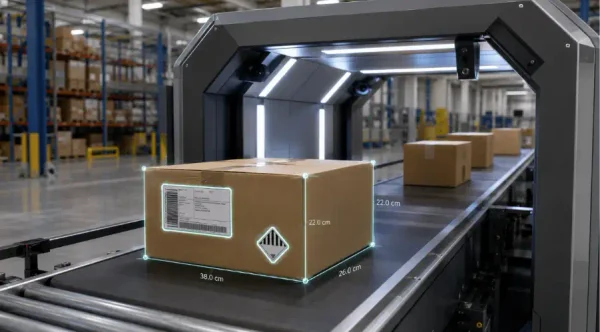
Today, many operations that capture parcel or package dimensions at all do it manually: an associate measures length, width, and height with a tape measure, or feeds parcels through a manual cubing station one at a time. It works at low volume, but it is slow, it pulls associates off other tasks, and the readings vary from person to person, which is a problem when the numbers feed billing or slotting.
Automated dimensioning captures the length, width, and height of a parcel or package as it moves through the scan tunnel, with no manual measurement step. Depending on the scan tunnel’s capabilities and configuration, this can happen in a second to a few seconds per parcel or package. The resulting dimensions flow to the WMS for slotting or item-master updates, and to shipping and rating systems where carrier-specific DIM-weight rules are applied.
DIM weight matters because carriers price each shipment on whichever is greater: the parcel’s or package’s actual weight or its volumetric weight. Volumetric weight is the parcel’s or package’s cubic dimensions divided by a carrier’s DIM divisor, and most carriers round each dimension up to the nearest inch before doing that calculation. So even a small error on a single dimension does not stay a one-time discrepancy; it compounds across thousands of shipments into a recurring billing cost.
Because a scan tunnel is a fixed station on the conveyor, dimensioning is captured at one defined point in the line. Operations decide where that point sits based on where dimensional data is most useful, whether that is inbound receiving, returns processing, or a quality-check stage.
Despite how often dimensioning is positioned as a default capability, every operation might not need it. It earns its place when dimensional variability directly affects cost or operational decisions, and the case gets stronger as more of the following apply:
● Operations building or maintaining an item master: Onboarding new SKUs need accurate dimensional data to populate the WMS, plan storage slotting, and support cartonization decisions. Manually measuring each new SKU with a tape measure does not scale past a handful of items a day, and the resulting data is often inconsistent across operators.
● 3PLs and operations billing by DIM weight: Any operation where carrier costs are tied to dimensional weight has a direct and recurring financial exposure to dimensional accuracy. For these operations, automated dimensioning is a billing accuracy tool with a measurable return, not an optional enhancement.
● Operations optimizing cartonization or slotting: Accurate dimensional data lets warehouses choose the right box size and storage location for each item, reducing void fill and wasted space across the facility.
The clearest example of where dimensioning doesn’t add much is apparel retailers receiving small, same-size parcels or packages. When inbound parcels are predominantly poly bags or small boxes of broadly similar dimensions, the per-item variance is too small to justify automated measurement over the consistent dimensions already in the system.
Since carriers bill on whichever weight is greater, capturing weight alongside dimensions in the same pass keeps the WMS and carrier billing fed from one consistent record, rather than two separate processes that can drift out of sync over time.
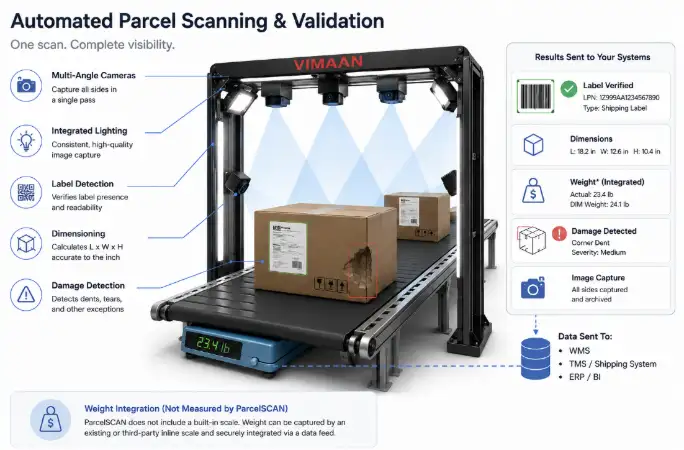
Weight is captured by an inline scale integrated at the scan point, not by the scan tunnel’s cameras. This matters when scoping a project: if a scale already exists on the line, weight can be added without new hardware; if one does not exist, sourcing and installing a scale becomes part of the project rather than something bundled in by default.
Most automated counting verifies that the number of parcels or packages moving through receiving or shipping matches the expected quantity. That is useful, but it overlooks a second, higher-value use case: counting the individual items inside an open box or tray as it passes through the scan zone. This matters in e-commerce, retail fulfillment, and pharmaceutical distribution, where contents have to be verified before packing, and the alternative is an associate opening every tray and counting by hand.
Vision-based item counting is well established in pharma, including pill and tablet counting in blister packs. Most existing solutions are template-based: the system is trained to recognize a specific item in a specific arrangement, and it counts reliably only as long as the contents match that template, so any change in the contents profile means reconfiguration.
A computer vision approach instead interprets the scene rather than matching a fixed template, the same capture-versus-interpretation distinction covered in our guide on Scan Tunnel Technology. This lets it handle variation in item type, orientation, and arrangement within the tray without retraining every time the contents profile changes.
Dimensioning, weight integration, and item counting are not separate systems bolted onto a scan station. In VImaan’s ParcelSCAN, all three are modular capabilities added to the same scan pass that already reads barcodes and label data, configured to what an operation actually needs.
Dimensioning is captured as part of that same image capture, so dimensional data is generated without a separate measurement step. Weight works differently: Vimaan does not manufacture or supply weighing equipment, instead it integrates with a customer’s existing inline scale, or partners with a weighing system provider where one needs to be added; either way, weight and dimension data are combined into a single record that feeds the WMS and carrier billing together. Item counting runs on the same computer vision approach used elsewhere in ParcelSCAN, interpreting the contents of a tray or box rather than matching a fixed template, so it handles variation in item arrangement without retraining every time the contents profile changes.
Because each capability is modular, operations configure them differently depending on their priority. An operation building an item master might run dimensioning alone. A 3PL billing by DIM weight typically pairs dimensioning with weight integration. A pharma operation might prioritize item counting alongside label inspection. None of these need a different base system, only a different configuration of the same underlying platform.
For a full breakdown of how modular configuration works across verticals, see: What Is a Scan Tunnel, and How to Know If You Need One?.
Q.What is DIM weight and why does it matter for shipping costs?
DIM weight, or dimensional weight, is a pricing method carriers use to charge based on the space a parcel or package occupies rather than its actual weight. It is calculated by dividing the parcel’s volume by a carrier-specific divisor. Carriers bill based on whichever is greater: actual weight or DIM weight. Because carriers round dimensions up to the nearest inch before calculating volume, even small measurement errors shift parcels or packages into a higher billed weight, and that cost compounds across every shipment.
Q.Does every warehouse need an automated dimensioning system?
No. The operations that see the clearest return are those building an item master, billing by DIM weight, or optimizing cartonization. Operations with largely standardized inbound packaging often find the investment better directed elsewhere. Vimaan’s ParcelSCAN is built to be modular, which means dimensioning can be added where it is needed rather than treated as a default requirement.
Q.How does weight integration work with automated parcel and package dimensioning?
Weight is captured by an inline scale at the scan point rather than by the scanning system itself. ParcelSCAN integrates with a customer’s existing inline scale, or with a scale added through a weighing system partner. The resulting weight and dimension data are combined into a single record for WMS and carrier billing.
Q.Can a scan tunnel count items inside a box, not just count boxes on a conveyor?
Yes, though the capability depends on the technology inside the tunnel. Computer vision-based systems can count individual items inside an open box or tray as it passes through the scan zone, not just count the boxes themselves. ParcelSCAN supports this for pharma and similar operations where trays contain a specific number of units, kits, or multi-packs that need verification before packing.
Q.What is the difference between counting parcels and counting items inside a parcel or package?
Counting parcels verifies that the number of packages moving through receiving or shipping matches the expected order or shipment quantity. Counting items inside a parcel or package verifies the contents of an individual box or tray, such as confirming a tray contains the correct number of units before it moves to packing. Both are counting use cases, but they answer different questions at different points in the workflow.
Q.Is automated dimensioning accurate enough for carrier billing?
Accuracy requirements depend on the carrier and the billing tiers involved, since carriers round dimensions to the nearest inch before calculating DIM weight. Automated dimensioning systems capture measurements precisely enough to avoid the rounding penalties that typically result from manual measurement error, which is where most billing discrepancies originate in the first place.
Q.What types of operations benefit most from combining dimensioning, weight, and counting in a single scan pass?
Operations that need multiple data points captured at the same point in the workflow see the most value: 3PLs billing by DIM weight, pharma operations verifying tray contents, and high-volume e-commerce warehouses managing outbound accuracy are the clearest examples. ParcelSCAN’s modular design means each capability can be added independently or in combination, without introducing separate systems for each data point.