

warehouse insider
Inventory accuracy is the measure of how closely your recorded stock levels match the physical inventory in a warehouse. In other words, if your systems say you have 100 units on the shelf, can you trust that there are exactly 100 units there? This KPI is critical – poor inventory accuracy leads to lost sales (from stockouts), excess costs (from overstocking), and operational chaos. Yet achieving high inventory accuracy is easier said than done. Studies have found that average inventory accuracy rates can be as low as 65% for many businesses. Even a 90% accuracy rate (10% of items counted wrong) is considered merely “good,” and world-class is around 95%. Clearly, there’s ample room for improvement in most warehouses.
When inventory records don’t align with reality, a cascade of problems ensue. Consider some common outcomes of poor inventory accuracy:
Hidden Shrinkage: Theft, damage, or misplacement might go unnoticed if your records aren’t reliable. Inventory could be “missing” or damaged without anyone realizing it until a physical count, at which point it’s too late to react.
Lost Sales & Stockouts: If the system thinks items are in stock when they’re not, you risk selling products you can’t actually fulfill. This means backorders, canceled orders, and disappointed customers.
Excess Stock & Waste: Conversely, bad data might indicate zero stock and trigger unnecessary reorders. You end up with overstock tying up capital or even expiring items on a shelf.
Picking and Shipping Errors: Inaccurate locations or counts lead to wrongly fulfilled orders – the picker grabs the wrong item or quantity. Products can even be shipped to the wrong customer due to mix-ups in staging or labeling, especially when an order is at the wrong dock or has an incorrect tag. These errors drive return costs and erode customer trust.

In short, poor inventory accuracy hurts both top-line revenue and bottom-line costs. One industry analysis noted that raising accuracy from 65% to 93% could boost sales by around 9%, purely by preventing stockouts and associated issues. For 3PLs and brands, maintaining high accuracy is not just a nice-to-have – it’s fundamental to operational efficiency, customer satisfaction, and profitability.
How do warehouses traditionally try to achieve 95–99% inventory accuracy? The primary method is cycle counting – continuously auditing portions of the inventory in waves so that every item is verified on a rotating schedule. In large facilities, this often means daily counts in some section of the warehouse. Workers are assigned specific aisles or zones to count each day, with the goal of catching discrepancies before they snowball. This process, repeated frequently, is how leading operations inch toward that vaunted 99% inventory accuracy.
However, manual cycle counting has serious drawbacks. It’s labor-intensive, slow, and prone to human error. As one Reddit user (a warehouse inventory specialist) lamented:
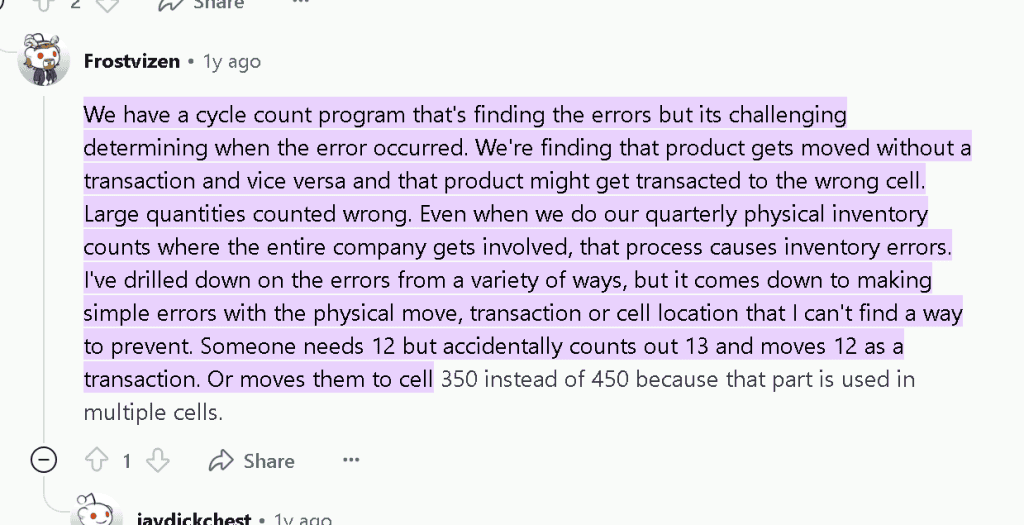
In other words, even with diligent counting, people make mistakes – mis-scans, mislabeling, counting 13 items as 12, putting stock in bin 3B instead of 4B, etc. Over time, these small errors add up and erode accuracy. To make matters worse, performing frequent counts can lead to “cycle count fatigue.” Counting inventory is a repetitive, mentally taxing task that requires a lot of focus.
Employees inevitably get tired or rushed, and fatigue leads to overlooking details and miscounts. (In fact, best practices for manual counts suggest taking breaks to rest, precisely to mitigate fatigue-related errors.) It’s no surprise that one frustrated retail employee who vented to Vimaan said, “Inventory in my store has long been garbage. I constantly find myself cycle counting stuff out because no one else wants to own up and do it.” The burden of maintaining accuracy falls on a few, and it’s a thankless, endless job.
The bottom line: manual processes struggle to sustain high inventory accuracy. They are too slow to catch issues in real time and too error-prone to ever reach 99%. This is where automation and AI enter the picture – and revolutionize the game, particularly in the storage phase of the warehouse.
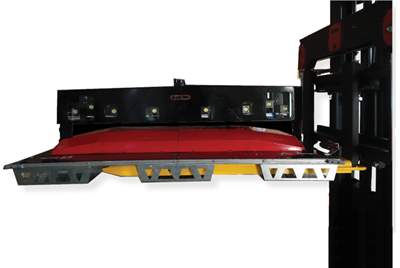
New AI-driven solutions are tackling the inventory accuracy problem by automating cycle counts in the storage phase. Instead of relying on employees to scan bins one by one, these systems use computer vision and smart sensors to continuously audit inventory on the shelves (at the “bin level”) with minimal human intervention. How does this work in practice?
One approach is to mount an array of cameras and sensors onto a mobile platform that travels through the aisles – for example, attaching a scanning module to a forklift. Vimaan’s StorTRACK system is an example of this technology: an operator can pick up the StorTRACK unit with any forklift or order-picker and drive down each aisle while the unit’s cameras automatically scan every pallet and bin from the floor to the top rack. As the device moves past, it captures high-resolution images, barcodes, and even text on labels for each location. In a single raised lift, it can “see” every item on an entire rack face, far faster than a person craning their neck with a handheld scanner.
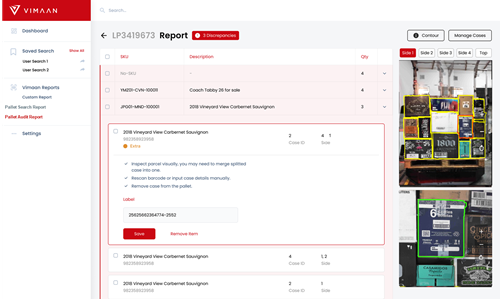
This process is repeated for each aisle, and the system’s AI cross-checks the visual data against the inventory records in the WMS (Warehouse Management System). Any discrepancies – a missing pallet, the wrong product in a bin, a quantity mismatch – are flagged automatically. Warehouse managers can then get a real-time discrepancy report and actionable insights (via a dashboard like Vimaan’s ViewDeck) to reconcile the errors immediately.
The advantages of automating cycle counts in storage are dramatic. First and foremost is speed. Machines can scan inventory much faster than humans. In fact, warehouses using automated scanning report cycle counts up to 10×+ faster than traditional manual methods (and even ~5× faster than drone-based inventory scans). A single StorTRACK unit can cover an area in minutes that might take a team of workers days to count. This high speed means you can cycle-count more frequently – even daily across the entire warehouse – with little added labor. Faster, more frequent counts ensure that any discrepancy is caught almost as soon as it happens.

Secondly, automated scanning greatly improves accuracy and consistency. Cameras don’t get tired or careless. They will diligently scan every location, every time, with the same thoroughness at 5 PM as at 5 AM. By removing human error from the counting process, warehouses can inch close to 100% inventory accuracy. AI vision is now sophisticated enough to read multiple barcodes or labels in one frame, recognize products, and count cases. All of this adds up to near-perfect visibility. As one case study reported, StorTRACK enabled 99.9% accuracy in stock data and eliminated production delays due to inventory discrepancies. In essence, with AI-driven cycle counts, the inventory in your system is the inventory you truly have on hand – a level of confidence that was unheard of with manual processes.
Another benefit is that these systems can operate with minimal disruption. An automated scanner can often work during operational hours, eliminating the need for shutdowns. For instance, StorTRACK is designed to function safely in active warehouse aisles, alongside forklifts and pallet jacks. This “always-on” inventory auditing means you don’t need to halt receiving or shipping to do tedious counts; accuracy assurance becomes part of the daily routine. And because the heavy lifting (literally and figuratively) is handled by machines, your staff are freed up from the drudgery of counting and recounting. Instead of walking aisles with clipboards or scanners, they can focus on higher-value tasks and simply address the exceptions that the system flags.

By concentrating on the storage phase of the inventory lifecycle, modern warehouses can achieve leaps in accuracy that were previously unattainable. Inbound and outbound checks are important, but it’s in the storage period – the weeks or months that products sit in racks – where many discrepancies creep in unnoticed. Automated cycle counting in storage addresses this gap directly. It provides a continuous “eye” on every bin, catching miscounts, misplacements, and shrinkage as they occur. The result is that inventory records stay truthful over time, not just right after a big physical count.
Imagine zero surprises during quarterly audits – because you’ve essentially been auditing every day. Imagine confidently telling customers that if the system shows an item in stock, it will be there. This level of accuracy isn’t a fantasy anymore; it’s becoming a reality with AI-driven inventory accuracy solutions. In short, “trust but verify” has never been easier – the AI verifies, so you can trust your inventory data.
Maintaining inventory accuracy will always be a challenge, but the storage phase no longer needs to be the weak link. By automating cycle counts and bin-level inspections, 3PLs and brands can dramatically increase inventory accuracy while reducing labor and fatigue. The technology here today makes near-perfect inventory accuracy a normal part of warehouse life. For businesses that have long struggled with inventory errors and endless manual counts, that is a game-changer.
In summary, inventory accuracy in the warehouse storage phase is finally being conquered. Automated cycle counting systems powered by AI and computer vision are delivering the double benefit of unprecedented inventory accuracy (nearly 100%) and significant labor savings. With these advancements, 3PLs and brands can ensure that their inventory records are always reliable, which means fewer operational surprises, happier customers, and a healthier bottom line. The storage aisle might just go from the largest problem to the cornerstone of inventory fidelity, thanks to AI scanning technology.