

warehouse insider
Warehouse receiving is the first touchpoint of goods entering the supply chain, and it plays a critical role in overall performance. This initial process—unloading deliveries, verifying them against purchase orders, and logging them into inventory—sets the stage for every downstream operation from putaway to picking and shipping. When executed well, warehouse receiving ensures products are accounted for accurately and ready to flow through fulfillment. But even small mistakes or delays at this stage can trigger a chain reaction of problems, causing inventory discrepancies, fulfillment delays, and ultimately customer dissatisfaction. In fact, industry data suggests over 60% of stock record discrepancies originate in the receiving process due to errors or lack of visibility during check-in. Such lapses in warehouse receiving can lead to misplaced stock, order delays, and unhappy customers down the line. Supply chain leaders increasingly recognize that strengthening this “front door” of the warehouse is essential to prevent downstream issues and maintain high customer service levels.
Despite its importance, traditional warehouse receiving processes are rife with challenges. Many warehouses still rely on manual checks and paper-based workflows that struggle to keep up with modern volume and accuracy demands. Key pain points include:
Manual, error-prone processes: Warehouse staff often record deliveries with pen and paper or spreadsheets, which leads to data entry errors and delays. Lacking real-time digital data or Advance Shipping Notices, teams operate with blind spots – planning falls apart when expected items don’t match reality. This not only causes receiving mistakes but also propagates errors into inventory records and subsequent workflows.
Labor-intensive verification: Checking packing lists, counting items, and inspecting goods by hand is slow and laborious. Warehouse receiving associates must identify SKUs, quantities, and damage manually, which is time-consuming and can hold up dock operations. Relying solely on human labor for pallet and carton inspections means throughput is limited and prone to fatigue-related mistakes. With an ongoing warehouse labor shortage, dedicating scarce staff to these tedious tasks is increasingly unsustainable.
Poor data capture and visibility: In manual receiving, important information can be missed or recorded incorrectly. Barcodes might be scanned one by one with a handheld scanner, and dimensions or visual conditions often go uncaptured on paper. This lack of visibility means inventory systems may not reflect reality until much later, if at all. Without accurate, timely data from warehouse receiving, downstream teams work with incorrect inventory counts and little traceability on vendor errors or damages.
Dock congestion and delays: Inefficient scheduling and processing can lead to trucks backing up at the docks. When multiple deliveries arrive at once without a clear plan, the receiving area gets congested, forcing rushed inspections and shortcuts. Limited dock space and staging areas amplify the problem – if one inbound load is stalled, it creates a bottleneck that slows everyone. These delays in warehouse receiving ripple outward, slowing putaway and reducing the overall warehouse throughput.
Inaccurate shipments and supplier errors: Discrepancies like incorrect quantities, missing items, or mis-labeled cartons are common headaches. With manual processes, catching these issues relies on keen-eyed workers. Inconsistent packaging or labeling practices by suppliers mean staff spend extra time sorting and verifying inbound goods. Often, problems are discovered only after the truck has departed, making it harder to hold vendors accountable. Without systematic controls at receiving, warehouses suffer higher rates of errors that later result in inventory write-offs or customer order shortfalls.
All these challenges make warehouse receiving a prime candidate for transformation. In an age where warehouses are expected to move faster and more accurately than ever, the traditional receiving process – with its clipboards, paper slips, and manual barcode scans – has become a weak link. The good news is that emerging technologies are poised to reinvent receiving and eliminate these longstanding pain points.

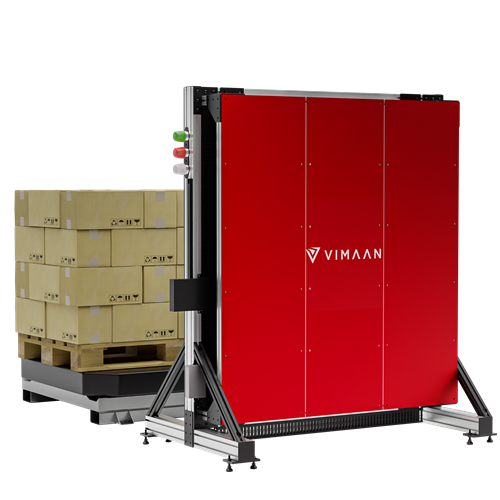
Warehouse receiving is undergoing a paradigm shift thanks to automation and computer vision technologies. Instead of human inspectors manually counting and recording every pallet and box, smart systems now capture shipment data automatically at the inbound dock. Solutions such as PalletSCAN and ParcelSCAN exemplify how advanced imaging and sensors can revolutionize this first step of the supply chain. These systems use a combination of cameras, computer vision, and AI to perform fast, touchless data capture of incoming shipments.
With PalletSCAN, for example, a forklift driver can simply bring a pallet through an automated scan station or turntable, and the system instantly captures all its identifying information. High-resolution cameras read barcodes on all visible sides of the pallet in one pass, even capturing text labels or SKU numbers for verification. The pallet’s dimensions and orientation are recorded automatically, and the system can count cases or even detect if a pallet’s stack height (Ti-Hi) matches the expected configuration. In fact, automated pallet receiving can process loads much faster than manual methods – warehouses have improved from handling one pallet every 3 minutes to up to 3 pallets per minute using these technologies. That is a dramatic increase in throughput, achieved by scanning all sides of a pallet simultaneously and eliminating the stop-and-go of handheld scanning.
At the parcel level, solutions like ParcelSCAN bring similar automation to packages and inbound cartons. ParcelSCAN systems feature conveyor-belt scanning tunnels equipped with multiple cameras and sensors. As packages feed through, the system automatically photographs and reads each label and barcode on incoming warehouse packages from all five visible sides in one sweep. There’s no need for an employee to pick up a box or fumble with a scanner gun – the computer vision captures the package ID, dimensions, and even text like purchase order numbers or addresses off the label. The moment a package is scanned, the system compares that data against the expected delivery information in the warehouse management system (WMS). If something doesn’t match – say the wrong SKU or an extra box that wasn’t in the advance notice – the system flags it in real time and alerts staff to the discrepancy. Every scan and image is logged, creating an auditable record of exactly what was received. By digitizing and automating warehouse receiving in this way, facilities get immediate, rich data on every pallet and parcel arriving at their dock.
Crucially, these automation solutions integrate with warehouse management or ERP systems to update inventory records instantly. As soon as a pallet or package is scanned, the quantities, SKUs, and condition data (including photos) are transmitted to the WMS. This tight integration means the books reflect reality without lag – there’s no delay between physical receipt and system receipt of goods. The result is a level of visibility and accuracy in warehouse receiving that far surpasses manual logging. Errors are caught at the door, data is recorded in real time, and warehouse staff can make decisions (like where to slot a pallet for putaway) based on up-to-the-minute information.
Equally important, automation reduces the heavy reliance on labor for receiving. Instead of a team of workers spending several minutes per pallet on scanning and paperwork, a single operator can oversee an automated scanner that processes multiple loads in the same time. By augmenting or replacing manual tasks with computer vision, warehouses can reallocate labor to higher-value activities. The improved speed and precision of automated warehouse receiving also means fewer exceptions to chase down later (e.g. investigating missing inventory or reconciling supplier errors), which saves management time. In short, automation turns receiving into a faster, safer, and more data-driven operation – one that sets a solid foundation for the rest of the supply chain.
Transforming warehouse receiving with automation and computer vision delivers far more than just efficiency gains at the dock. It creates strategic ripple effects that improve supply chain performance end-to-end.
Key benefits include:
Improved Inventory Accuracy: Automated receiving ensures that what arrives is correctly identified, counted, and recorded, dramatically reducing discrepancies. Since the system captures each pallet or carton exactly as delivered, inventory records in the WMS stay accurate from the start. This eliminates the common errors introduced during manual receiving, a major reason over 60% of stock discrepancies originate at receiving in the first place. With warehouse receiving data validated and synced immediately, downstream processes like picking and replenishment can trust the inventory on hand. In essence, automation provides a “single source of truth” for inventory by feeding the WMS precise, real-time data, which in turn leads to fewer stockouts, less safety stock padding, and a leaner operation.
Faster Putaway and Throughput: Speed is a huge advantage of automating warehouse receiving. By processing inbound loads quickly and with minimal human intervention, warehouses shorten the dock-to-stock cycle time. Pallets that might sit waiting for a clerk’s check can be scanned, verified, and released to putaway in a fraction of the time. The throughput improvements (e.g. 3x more pallets received per minute as noted above) mean containers are unloaded and cleared faster, reducing bottlenecks at the docks. Faster receiving directly translates to faster putaway – products get into their storage locations or forward picking areas sooner, making them available for sale or production. Overall, a streamlined receiving process increases warehouse capacity and flow, enabling quicker order fulfillment. Studies show world-class facilities achieve dock-to-stock times under 2 hours by pairing advanced receiving automation with directed putaway strategies. This acceleration boosts the facility’s responsiveness to demand and can compress the total order cycle time.
Stronger Vendor Accountability & Reduced Chargebacks: Automated warehouse receiving provides a new level of transparency into supplier performance. Every shipment is documented with timestamps, quantities, and high-resolution images of the goods as they arrived. When a vendor’s delivery has missing items or damage, the system captures it immediately, creating indisputable evidence. This data empowers procurement and supply chain teams to hold vendors accountable. Companies can institute vendor scorecards and compliance programs based on the automated receiving reports – for instance, flagging recurring issues like incomplete POs or improper labeling. Some organizations even implement charge-back programs that penalize vendors for errors or non-compliance, using the receiving audit trail as support. Over time, this accountability drives suppliers to improve their accuracy and reliability to avoid penalties. Fewer inbound errors from vendors means fewer operational headaches for the warehouse, and any chargebacks that do occur help offset the cost of disruption. In short, automation turns receiving into a source of vendor performance insight, strengthening upstream supply chain relationships.
Better OTIF and Customer Satisfaction: On-Time In-Full (OTIF) is a critical metric that measures how often customers get what they ordered, when they expect it. Automating warehouse receiving helps improve OTIF performance by ensuring inventory accuracy and product availability from the very start of the fulfillment process. When inbound goods are checked in correctly and quickly, there are no surprises later – the stock is on the shelves and ready to pick, so customer orders ship complete and on schedule. This reduces the likelihood of backorders or last-minute expediting that occur when an expected item isn’t actually in inventory due to a receiving error. High OTIF scores have been directly linked to greater customer satisfaction and trust, since customers reliably receive their full orders on time. In the bigger picture, a smooth receiving operation contributes to a more agile supply chain that can respond to demand without delay. By eliminating the delays and inaccuracies at the dock, automation helps ensure the rest of the supply chain runs like clockwork, culminating in better service levels and happier customers.
For years, warehouse receiving was treated as a back-of-house function – a necessary but overlooked step of moving goods into storage. Today, forward-thinking supply chain executives are reimagining receiving as a strategic control point for building efficiency and visibility from the moment products arrive. Automation and computer vision have redefined what’s possible at the dock: instant data capture, verification, and system updates that ripple benefits through inventory management, labor utilization, and supplier relations. By investing in modern receiving solutions like PalletSCAN and ParcelSCAN, organizations turn the once paper-clogged receiving dock into a high-tech nerve center that feeds accurate information into their enterprise systems in real time. The result is greater confidence in inventory, faster throughput to downstream processes, and the ability to enforce quality from suppliers. In an era where supply chain agility and accuracy are paramount, warehouse receiving is no longer “just” a backdoor process – it’s a linchpin of supply chain success and a prime opportunity for competitive advantage. Executives who optimize this first step will gain end-to-end visibility and control, starting at the warehouse door, and set the tone for excellence across their entire supply chain.