

warehouse insider
Written By: Raushan Barnwal | Reviewed By: SK Ganapathi (KG) | Created On: 13-Oct-2026
Inventory intelligence is the ability of a warehouse to understand its inventory in full physical context, using AI and computer vision to capture what is present, how much of it there is, where it sits, what condition it is in, how it is configured and what information its labels carry, and then to turn that understanding into verified, near real-time data that operations teams can act on.
Where a barcode or a tag confirms the identity of an item, inventory intelligence confirms the physical state of the inventory behind that identity, and it attaches visual evidence to every operational event so that discrepancies, damage and disputes can be resolved against what the cameras actually saw.
The term is also used in a different sense for forecasting, planning and analytics software that works on top of data already held in a WMS or ERP, whereas the sense used here sits upstream of that software, because it is concerned with creating accurate inventory data automatically from the physical warehouse, which analytics and planning tools can then rely on.
Inventory tracking and inventory visibility are closely related and are often used interchangeably, so this guide treats them together. Industry definitions describe inventory tracking as the systems and methods a company uses to monitor how goods move through the supply chain, whether those methods are manual or software-based, and inventory visibility as the resulting ability to track and monitor the location, quantity, status and movement of inventory, often in real time or near real time. In modern warehouses both are frequently automated, using barcode scanners, RFID readers, IoT sensors, machine vision cameras, WMS and ERP platforms that update continuously.
Inventory intelligence is a superset of inventory visibility, because it does everything visibility does, such as reading barcodes and labels and recording where inventory is, how much of it there is and how it is moving, and then goes further by understanding the physical state of the inventory itself. Visibility on its own reads an identifier or matches a pre-defined pattern at a known point in the process and records the result, which makes it very effective at answering what was scanned and where, but limits what it can say about whether a pallet is complete, whether a case is damaged, or whether a load is configured safely for the automation downstream.
Inventory intelligence includes inventory visibility and goes further:
| Inventory Visibility and Tracking | Inventory Intelligence | |
| Core question | What do we have, where is it, and what are its status and movement? | What is physically present right now, in what condition and configuration, and does it match what the system expects? |
| How it perceives inventory | Reads identifiers such as barcodes or RFID tags, or matches pre-defined patterns, at defined points, and combines that data with system entries into a shared view across sites and channels | Does everything visibility does, and also uses AI and computer vision to understand the whole scene, reading text and labels, counting, measuring and assessing condition |
| Typical technologies | Barcode scanners, RFID, IoT sensors, machine vision, WMS, ERP, dashboards, alerts and automated reconciliation | A computer vision platform of cameras, sensors and AI models that reconstructs entire scenes of inventory, and also reads barcodes and labels, integrated with the WMS or ERP |
| What it tends to miss | Condition, configuration and anything not encoded in the identifier or captured by a pre-defined rule | Anything outside the workflows and locations where capture is deployed |
Warehouse automation has developed in three waves, and the easiest way to understand them is through the analogy of a person at work, where the hands and legs move things, the eyes see them, and the brain understands what is being seen.
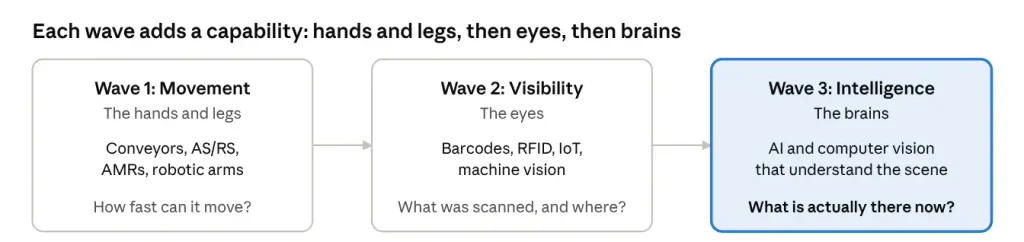
Wave 1 — Movement, the hands and legs: Systems such as AS/RS, AMRs, high-speed conveyors, sortation and robotic arms took over the physical work of moving goods, so warehouses can now move boxes, pallets and parcels faster and more consistently than manual labor ever allowed, although moving goods quickly says nothing about whether the right goods, in the right condition, are the ones being moved.
Wave 2 — Visibility, the eyes: Barcode scanners, RFID, IoT sensors and machine vision systems took over the work of seeing, giving warehouses automated ways to identify items and record where they are, and these tools remain valuable, but they are built to read specific identifiers or match pre-programmed patterns, which makes them largely transactional and leaves them without the context to understand the object in front of them.
Wave 3 — Intelligence, the brains: AI and computer vision add the understanding that sits behind the eyes, interpreting an entire scene the way an experienced person would, in order to judge whether inventory is what it claims to be, whether a pallet is complete, whether it is over-height or has an overhang that could jam equipment, whether it is damaged and whether its labels and markings are correct, and doing so continuously and with visual evidence.
Without the third wave, automation tends to accelerate errors instead of correcting them, because a misconfigured pallet entering an AS/RS does not wait for someone to notice it, and a damaged shipment missed at receiving does not disappear but resurfaces weeks later as a claim dispute.
Vimaan first introduced this three-wave framing in Inventory Intelligence: How AI Is Leading the Third Wave of Warehouse Automation, published in RoboticsTomorrow.
Most warehouses operate across more than one wave at the same time, so the practical question is which wave governs day-to-day inventory decisions in each workflow, such as receiving, storage and shipping.
| Signal | Wave 1: Movement (hands and legs) | Wave 2: Visibility (eyes) | Wave 3: Intelligence (brains) |
| How inventory is identified | Largely by people, with limited automated identification | By barcode, RFID, or pattern-based machine vision at defined points | By AI and computer vision that reads labels and also understands the whole scene |
| How discrepancies are found | During shipments, audits, or customer complaints | Through scheduled counts, reconciliation, or alerts based on recorded data | Near real-time, at the point where the physical event happens, with visual evidence |
| What the system knows about condition and configuration | Very little | Mostly what the identifier or a task-specific rule can reveal | Count, condition, dimensions and configuration of what is physically present |
| Main cost of errors | Lost or misplaced inventory and the manual effort to find it | Labor spent on recounts, audits and dispute investigation | Reduced, because exceptions are flagged with evidence instead of being searched for |
| Risk to automation equipment | Low, since there is little automation to disrupt | Moderate, because unverified loads can still reach conveyors and AS/RS | Lower, because non-compliant loads can be flagged before they reach the equipment |
Moving to the third wave does not require replacing the second-wave infrastructure already in place, since inventory intelligence verifies and enriches what those systems report and sends the verified data into the existing WMS or ERP.
Four areas of the business feel the difference most directly, and each of them shows up in operating results that warehouse leaders already track.
1. Labor cost: Counting, checking and investigating discrepancies absorb a large share of warehouse headcount in most operations, and automating that verification lets those people move to work that genuinely needs human judgment instead of repeating mechanical checks.
2. Inventory accuracy: When inventory records match physical reality, warehouses see fewer stockouts, can hold less safety stock against uncertainty and can make fulfillment commitments that customers and downstream partners can depend on.
3. Claims, chargebacks and disputes: When every receiving and shipping event carries a timestamped visual record, retailer and 3PL chargebacks for mis-shipments, shortages, or damage can be contested with evidence, and in many cases prevented before the shipment leaves the dock.
4. Automation uptime: As warehouses add conveyors, AS/RS and robotics, their tolerance for bad inventory data falls toward zero, because a pallet with an overhang, a lean, or an out-of-spec dimension can jam a conveyor or damage equipment, which is why inventory intelligence works as a precondition for automation to run without interruption and not merely as a complement to it.
Vimaan’s AI-powered computer vision platform works in three steps: smart cameras and sensors placed at critical workflows capture the barcodes, label text, count, condition and configuration of the inventory; proprietary AI and ML models then stitch images from every angle into a digital twin of that inventory; and advanced analytics show deviations against the WMS or against expectations, such as count mismatches, damage, missing labels and misconfigurations, each backed by source images.
The same platform powers three products, each built for a different workflow, so operations teams do not have to stitch together separate vendors as they automate more of the warehouse.
| Workflow | Vimaan Product | What It Verifies |
| Inbound receiving | PalletSCAN for pallets and ParcelSCAN for parcels | Every inbound pallet and parcel as it arrives, catching mismatches and misconfigurations before they become a problem and pushing verified data into the WMS automatically |
| Storage | StorTRACK | The count, location and condition of stored inventory, through fully autonomous and semi-autonomous solutions that keep records aligned with what is physically on the racks |
| Outbound shipping | PalletSCAN for pallets and ParcelSCAN for parcels | Every outbound pallet and parcel against its order before it ships, flagging mismatches and misconfigurations and creating photographic records that help resolve disputes before they escalate |
Verified results flow into the existing WMS or ERP, so Vimaan works alongside those systems and the automation already on the floor instead of replacing them, which means a warehouse can add the third wave on top of the first two without re-architecting what it has, and can extend the same platform to new workflows as its operations and automation continue to grow.
To see how inventory intelligence would apply to the inbound, storage and outbound workflows in your own warehouse or distribution center, talk to one of our experts.
Q. What is inventory intelligence in a warehouse?
Inventory intelligence is the use of AI and computer vision to understand inventory in full physical context, including what is present, how much, where it is, what condition it is in and how it is configured, and to turn that understanding into verified, near real-time data with visual evidence behind it.
Q. Is inventory visibility the same as inventory intelligence?
No, because inventory intelligence includes inventory visibility and goes further than it. Visibility rests on tracking methods that can be manual or automated with barcodes, RFID, sensors and machine vision, and it tells you what was identified and where, whereas inventory intelligence adds an understanding of the physical state of the inventory, such as damage, missing cases, or unsafe configurations, which identifiers and rule-based systems cannot detect on their own.
Q. How is computer vision different from machine vision?
Machine vision systems are typically rule-based and built for specific tasks in controlled conditions, matching pre-programmed patterns against known objects, whereas computer vision uses AI models that interpret the whole scene, so the same captured imagery can answer many different questions without a new system being designed for each one.
Q. Is inventory intelligence the same as inventory analytics or forecasting software?
No, because analytics and forecasting platforms generally work on transactional data that is assumed to be accurate, while inventory intelligence generates that data from the physical warehouse and verifies it, which gives analytics and planning tools a more reliable foundation.
Q. Does inventory intelligence replace a WMS?
No, since verified data is pushed into the existing WMS or ERP, and the WMS continues to serve as the system of record.
Q. Why does inventory intelligence matter more as warehouses add automation?
Automation moves inventory faster but does not check it, so an unverified or non-compliant load can jam a conveyor or damage AS/RS equipment, and verified inventory data helps keep that automation running without interruption.