

warehouse insider
Mixed pallet configurations—often called “rainbow pallets”—consist of multiple SKUs stacked onto a single pallet. While this setup supports flexible fulfillment and retailer variety demands, it poses significant accuracy challenges in high-volume 3PL environments. Manual handling of a mixed pallet is labor-intensive and fraught with errors. For example, verifying the contents of a mixed pallet often requires scanning under shrink wrap which slows operations.

In workflows involving mixed case palletizing, where different product types and sizes are strategically arranged together on a pallet, the complexity increases even further. Every deviation from standard, uniform loads makes receiving, put-away, and outbound processes more difficult to manage. Likewise, mixed case SKU palletizing scenarios often feature pallets with inconsistent labeling, irregular carton shapes, and diverse weight distribution, increasing the potential for labeling issues, miscounts, and shipping errors.
As a result, warehouses frequently encounter discrepancies between WMS records and physical inventory, leading to rejected shipments, chargebacks, and dissatisfied customers.

Inbound Verification: High volumes of mixed pallet deliveries make rapid and accurate receiving difficult. Relying on advance shipping notices (ASNs) isn’t sufficient when the contents must be physically verified. Especially in mixed case palletizing scenarios, a missing SKU or mislabeled case can go unnoticed without full counts.
Damaged or Misplaced Labels: In mixed case SKU palletizing, cases are stacked non-uniformly, making barcode placement inconsistent. Pallet-facing labels may be obscured by shrink wrap, torn, or simply missed during manual scans, leading to incorrect entries in the WMS.
Sorting Complexity: A mixed pallet may include fragile items, variable case sizes, or tightly packed high-SKU assortments. Without automation, staging and validating these loads manually slows throughput and introduces mistakes, especially during outbound staging when accuracy is critical.
When a mixed pallet arrives at a 3PL facility, the receiving process quickly becomes a bottleneck. Each mixed pallet must be manually reconciled against ASNs and purchase orders, often without full confidence in supplier data. In most cases, staff resort to full piece-counting, unpacking, and verifying the quantity and SKU of each master carton. This practice, while necessary in mixed cased SKU palletizing environments, is slow and highly susceptible to human error.

Even with barcodes, manual scans fall short when cartons are wrapped tightly or stacked irregularly, which is common in mixed case palletizing strategies. If a mixed pallet is unlabeled or ambiguously marked as “MIXED,” or if the packing list lacks detail, the warehouse must allocate additional labor for inspection and cross-checking. Receiving clerks may inadvertently accept the wrong quantities simply because the ASN was incorrect, but there was no streamlined method to validate what actually arrived on the mixed pallet.
The downstream effects are costly: inflated labor hours, delayed put-away, and ripple effects on fulfillment timelines. As one fulfillment director put it, “Manual barcode scanning during mixed pallet receiving is time-consuming and prone to human error.” In high-volume operations, these inefficiencies multiply fast, reducing throughput and making inbound receiving one of the least scalable parts of the warehouse.
On the outbound side, verifying that the correct mixed pallet leaves the warehouse is just as critical as inbound accuracy, but far more complex under pressure. Load verification for mixed case palletizing typically requires multiple barcode scans, manual inspection of carton labels, and reconciliation against the shipping manifest. Supervisors often mandate secondary visual checks, especially for mixed cased SKU palletizing configurations, but this introduces bottlenecks and drains labor during peak shipping windows.
In fast-paced 3PL environments, the margin for error is thin. If even one case is missing or mislabeled on a mixed pallet, it can result in costly chargebacks, failed QA audits, or rejected deliveries. As one industry expert warns, “Inaccurate scans, damaged labels, and slow manual checks can lead to misrouted shipments,” which degrades client satisfaction and forces costly rework.
While some facilities install fixed dock door scanners, they rarely capture the full picture, especially for mixed pallets with SKUs on multiple sides. Pallets must often be rotated or broken down, wasting time and increasing the chance of errors. Manual scanning simply isn’t scalable for outbound QA, particularly when every mixed cased SKU palletizing load is unique.
Correct load-out has become a pain point. In many manual operations, there’s no system to generate real-time alerts for discrepancies or missing items on mixed pallets. This makes outbound error detection largely reactive. By contrast, automated pallet scanning solutions—such as Vimaan’s PalletSCAN360—deliver full-pallet validation in seconds. These systems verify all visible SKUs, catching label damage, count mismatches, and placement errors before the pallet is even loaded. Vimaan notes that customers using automated verification have reduced chargebacks and reverse logistics significantly, cutting avoidable costs from shipping mistakes.
Ultimately, the complexity of mixed case palletizing demands smarter outbound validation tools. In a high-throughput 3PL, manually checking every mixed pallet isn’t just inefficient—it’s unsustainable. That’s why computer vision solutions are quickly becoming a standard in future-ready outbound QA workflows.
Conventional barcode and RFID methods each have blind spots in mixed-pallet auditing. Handheld barcode scanning requires operators to stop and scan individual labels, which is too slow for dozens of labels per pallet. Damaged or obscured barcodes often fail to read, as noted above.
PalletSCAN360 is a new autonomous solution built for mixed-pallet reality. It combines AI-driven computer vision with a multi-sided scanning station so pallets can be checked instantly and continuously. In this system, a forklift drops a pallet onto a rotating turntable. In as little as ~15 seconds, high-definition cameras capture every visible box face. The machine vision algorithms then read all barcodes and text, detect case outlines, measure dimensions, and even spot damage or label errors. In effect, every case on the pallet is scanned and validated without manual intervention.
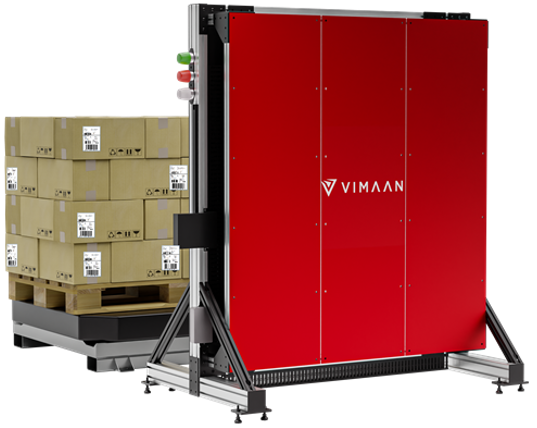
The AI software rapidly reconciles the pallet contents against the expected manifest. It flags any discrepancies – e.g., missing cases or wrong SKUs – immediately. For example, if a pallet’s manifest lists 50 cases but the scan detects only 48, the system highlights the two missing cases. Likewise, if a case barcode doesn’t match the order, it’s highlighted. All captured data (barcodes, OCR text, even pallet photos) are stored in a digital record. The result is a “zero-touch” audit: the system essentially does in seconds what would take many minutes by hand.
PalletSCAN360 is also designed for real-time integration. Its software layer connects to the warehouse’s WMS/ERP, syncing inventory counts as pallets are scanned. This means the WMS is updated instantly when a pallet clears the scanner, rather than waiting for a forklift scan or manual entry. The Vimaan platform provides an intuitive web portal (ViewDECK) so inventory managers anywhere can review scans and alerts. In short, PalletSCAN360 eliminates forklift stops and manual scans. It continuously monitors pallet flows, ensuring mixed pallets are validated on the fly. This level of automation allows 3PLs to retire legacy handheld-scanner workflows and scan tunnels, as one industry leader who spoke with VImaan notes, “without requiring your workers to stop and scan each barcode.”
Fast Inbound Audits: Imagine a beverage distributor unloading ten mixed-brand pallets. With PalletSCAN360, each pallet is scanned the moment it’s unloaded. Any deficit (say a pallet is missing a case of an energy drink) pops up instantly. In contrast, manual checks might not catch this until hours later. This immediate validation prevents inventory errors and supplier disputes. In fact, real implementations of multi-sided scanning report near-instant alerts.
Automated Shipping Verification: On the outbound side, PalletSCAN360 can act as a dockside verification gate. As mixed pallets roll toward the loading dock, they pass through the scanner. The system verifies each pallet’s contents and dimensions without slowing down the forklift; operators can drive pallets into the trailer while cameras do the checking. Any anomalies (extra boxes, wrong items, carton damage) are logged on the spot with high-res images for proof. This capability is akin to advanced “gatekeeper” dock scanning technology but uses 4‑side vision instead of just front-view cameras. The result: virtually no load gets shipped unchecked.
Reallocating Labor: In a hypothetical mid-size 3PL, switching to PalletSCAN360 could free one or more full-time staff per shift. Those employees could be reassigned from slow pallet audits to higher-value tasks (like slot optimization or exception handling). One recent industry study found that warehouse automation of this type can cut manual audit labor by 70% or more. In practice, managers report that tasks like cycle counting mixed pallets become so fast and automated that cycle count teams can shrink by half.
Adopting AI-powered pallet scanning drives measurable business results. Mixed-pallet auditing moves from being a liability to an automated strength. Key outcomes include:
Labor and Throughput Gains: By automating pallet audits, labor previously spent on counting or scanning can be redeployed. Studies show customers cutting their manual labor time dramatically, often on the order of 70% or more in audit tasks. Operations leaders can shift those workers to productive roles (e.g., replenishment, returns processing). Overall throughput increases because forklift operators are no longer idle for manual scans.
Inventory Accuracy: Continuous multi-sided scans ensure inventory records match reality. PalletSCAN360’s data capture “improves inventory accuracy” by detecting missing/extra items before they enter the system. In one analysis, automated scanning of high-volume operations maintained near-100% accuracy, whereas manual methods typically suffer 1–5% shrinkage or miscounts over time. This precision boosts customer trust and reduces costly fulfillment errors.

Reduced Errors and Cost Avoidance: Fewer mis-shipments and disputes mean lower chargeback and return costs. By catching mistakes automatically, warehouses report a sharp decline in shipping errors. In practice, even a single prevented error on a big shipment can offset a scanner system’s cost. Vimaan products can also generate a searchable archive of images that can be used for chargeback claims, inventory research, and resolving downstream issues—providing an added layer of visibility and accountability across warehouse operations.
Taking a strategic view, modernizing mixed-pallet handling aligns with broader supply chain goals. AI-driven vision systems like PalletSCAN360 provide a scalable audit platform. When customer requirements or SKU assortments change, the system simply sees and reads whatever comes in, with no new programming needed. Over time, the data collected also supports process improvements: analytics on how often certain SKUs get mis-shipped, which carriers tend to damage pallets, etc. This information feeds continuous improvement in quality programs and labor planning.
Mixed pallets are here to stay in high-volume 3PLs, but managing them no longer needs to be a chaotic manual affair. By replacing ad-hoc barcode scans and cycle counts with automated 4‑side computer vision, warehouses can transform a pain point into a precision process. Systems like Vimaan’s PalletSCAN360 demonstrate how emerging AI solutions deliver 3PLs unparalleled inventory tracking and validation. For warehouse directors and operations leaders, the takeaway is clear: investing in vision-based pallet auditing pays off in terms of accuracy, throughput, and return on automation. Mixed pallets aren’t going away, but manual validation is. With Vimaan’s PalletSCAN360, 3PLs can finally solve the mixed case palletizing challenge and eliminate guesswork from inbound and outbound operations.