

warehouse insider
In the fast-paced world of third-party logistics (3PL), warehouse accuracy and efficiency are everything. Yet many 3PL warehouses struggle with persistent challenges: inventory records that don’t match reality, underutilized storage space, and labor-intensive tracking processes. In fact, one analysis found that most warehouses use less than 50% of their potential storage capacity, which can cost businesses over $11 per square foot in wasted space. Such inefficiencies lead to real costs – from surprise carrier fees due to mis-measured pallets, to retailer chargebacks for shipments that don’t meet specifications. The good news is that new technologies and best practices are emerging to tackle these issues head-on. In this article, we explore how adopting a pallet dimensioner, optimizing ti hi pallet configuration, and leveraging robust WMS integration can dramatically improve warehouse accuracy, warehouse space utilization, and inventory tracking for 3PL operations.
A pallet dimensioner is an automated system that accurately measures the length, width, and height of a palletized load – and often captures weight and other data – in a matter of seconds. In essence, a pallet dimensioner replaces the tape measures and clipboards of yesterday with sensors and software for instant, precise measurements. For example, modern dimensioners use 3D scanners or camera-based computer vision to record a pallet’s exact dimensions and volume. Many systems integrate with scales, so the pallet’s weight is recorded simultaneously. Once a pallet passes through the measuring zone (or the device is brought to the pallet), the pallet dimensioner automatically logs the data – no manual input required – and pushes it to connected systems in real time.
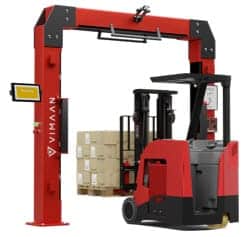
Crucially, today’s pallet dimensioners are designed to slot neatly into existing workflows. A forklift driver can simply pick up a pallet and drive through a dimensioner “gate” without stopping, and the system will scan the load from all sides as it passes through. In as little as 10–15 seconds, the pallet’s size, weight, and even details like barcode data or a photo of the load are captured. This is a game-changer compared to manual measuring – for instance, one case study showed that automated drive-through scanning cut per-pallet measurement time from about 2 minutes to under 10 seconds. By eliminating the “stop-and-measure” bottleneck, warehouses can dramatically speed up inbound and outbound processing. In fact, capturing pallet dimensions in seconds can increase processing speeds by over 50%, freeing up valuable dock space and labor capacity for other tasks. And because the data capture is electronic, the pallet dimensioner can instantly flag issues (such as an overhung load or a pallet stacked too high) and send the information where it needs to go.

Efficient palletizing isn’t just about stacking things up – it’s about stacking them right. This is where ti hi pallet configuration comes in. “Ti-Hi” (short for “tie-high”) is a common term in warehousing that refers to how a pallet is packed: Ti (tie) is the number of cases/cartons per layer on a pallet, and Hi (high) is the number of layers tall the pallet is. For example, if a product’s spec sheet says its ti hi pallet configuration is 10×4, that means you can fit 10 boxes on each layer and stack 4 layers high (for a total of 40 per pallet). Optimizing this ti hi pallet configuration is critical for maximizing space and stability on each pallet. When you load pallets with the ideal TI/HI pattern, you utilize every inch of pallet space while keeping the stack safe for handling and transport.

Why does this matter so much to 3PL executives? First, warehouse space utilization. A proper ti hi pallet configuration means more product per pallet, which in turn means fewer pallets occupying your racks and trailers. Over the course of hundreds or thousands of pallets, the savings in warehouse space and trucking capacity are substantial. Second, damage prevention and safety. An incorrect pallet stack (for instance, too many layers causing an unstable “pyramid” shape, or boxes overhanging the pallet edges) can lead to product damage or even accidents. By adhering to the right ti/hi ratio, you reduce the risk of overhanging cartons that could be crushed or cause the load to topple. Proper ti hi pallet configuration thus prevents costly mishaps – including freight reclassification fees or retailer fines that happen when pallets aren’t built to specification.
Achieving the optimal ti/hi for each SKU often requires accurate item dimensions and thoughtful planning. This is another area where a pallet dimensioner proves valuable: by providing exact measurements of products and pallets, it enables warehouse software to calculate the best pallet patterns. Some modern dimensioning systems even detect if a pallet load has issues like leaning or overhang and alert the team before that pallet leaves the floor. In practice, 3PLs can store standard ti/hi data in their systems (or get it from suppliers) and train staff or automated systems to build every pallet to that spec. The result is an efficient ti hi pallet configuration on the warehouse floor that improves cube utilization and protects inventory in transit.
Implementing pallet dimensioners and enforcing ti/hi standards can yield a lot of valuable data – but to truly unlock their potential, you need WMS integration. A Warehouse Management System (WMS) is the software brain of your warehouse, tracking inventory locations, orders, and movements. WMS integration means connecting your dimensioning and scanning tools directly into that WMS, so that all data flows into one source of truth. The moment a pallet dimensioner measures a pallet, those exact dimensions (and potentially weight, images, and item counts) are recorded into the WMS record for that pallet or SKU. When your team builds a pallet following the prescribed ti hi pallet configuration, they can scan it or weigh it, and the WMS immediately knows if it matches the expected configuration. Essentially, WMS integration ties together these technologies to give you real-time, granular visibility into your inventory and operations.
The benefits of this kind of integration are huge for accuracy and efficiency. First, it eliminates manual data entry – no one has to key in dimensions or counts, which reduces errors and labor. By automating these processes, warehouses see faster and more accurate receiving, put-away, and shipping transactions. Second, integration provides real-time inventory accuracy. Every pallet scanned or measured updates the system instantly, helping maintain inventory accuracy rates in the high 90s. (Industry benchmarks consider ~98-99% accuracy as best-in-class, and integration helps consistently hit those numbers.) Third, WMS integration yields end-to-end visibility and better decision-making. Managers and even customers can get up-to-date information on stock levels, pallet dimensions, and available space at any time. This makes it easier to optimize truck loading (since you know the exact size of every pallet for load planning), slotting (since you know the cubic footprint of inventory for storage locations), and order fulfillment. Modern AI-powered warehouse solutions make integration even more seamless. For instance, AI computer vision systems like those offered by Vimaan are designed to plug into any major WMS – they don’t replace your existing system, but rather enhance it by feeding in the latest floor-level inventory data. With such WMS integration, 3PL warehouses achieve a unified workflow where pallets are automatically scanned, verified, and updated in the inventory system without missing a beat. The result is a warehouse that essentially “sees” and records everything that happens to each pallet, bridging the gap between physical operations and digital records.

By combining pallet dimensioners, optimized ti/hi practices, and strong WMS integration, 3PLs can unlock a host of benefits that directly impact the bottom line:
Improved Planning and Responsiveness: The rich data collected through dimensioners and WMS integration doesn’t just help in the moment – it also feeds better planning. With historical data on pallet sizes, weights, and configurations, a 3PL can analyze trends to optimize warehouse layout and capacity planning. You can foresee when you’ll run out of space or need more trailers because you know the exact cubic volume of incoming inventory. Plus, real-time visibility from WMS integration enables more responsive decision-making. If an urgent order comes in, you can immediately locate a pallet (via scanned data) and know its dimensions for shipping. If a certain product’s ti hi pallet configuration changes (say, new packaging allows more per layer), you can adjust your systems quickly. Essentially, the warehouse becomes smarter and more agile – ready to adapt to customer demands or supply chain disruptions with data-driven confidence.
For 3PL executives seeking to elevate their warehouse operations, the combination of pallet dimensioners, ti-hi pallet configuration optimization, and deep WMS integration offers a powerful path forward. These tools and practices directly address the classic pain points in warehousing: they drive up accuracy, drive down waste, and create a more automated, intelligent workflow. The result is a warehouse that operates with precision – every pallet accounted for, every inch of space put to use, and every piece of data flowing into your system of record.
While we’ve highlighted the technologies, it’s worth noting that success comes from aligning people and processes with these tools. Training staff on ti hi pallet configuration standards, integrating the pallet dimensioner into standard operating procedures, and configuring the WMS integration properly are all key steps to realizing the full benefits. The effort is well worth it. Warehouses that have embraced AI-powered automation and integration, like those from Vimaan and others, are already seeing faster throughput, lower costs, and happier customers.
As a 3PL decision-maker, you don’t have to overhaul everything at once – even small steps, like automated pallet measurement at inbound or auditing pallet builds for ti/hi compliance, can yield quick wins. The future of warehousing is data-driven and autonomous. By taking a top-of-funnel look at solutions like pallet dimensioning and integrated inventory tracking now, you’re positioning your operation to thrive in a logistics landscape that demands accuracy and agility.
Interested in exploring how AI-powered pallet scanning and inventory visibility tools could fit into your warehouse? Take the next step by learning more about advanced WMS integration solutions or requesting a demo of a pallet dimensioner in action. With the right blend of technology and strategy, your 3PL warehouse can achieve new levels of efficiency and reliability – turning these challenges into your competitive advantage.