

warehouse insider
Warehouse scanning systems are a combination of hardware and software tools that capture critical data on goods and shipments as they move through the facility. These solutions – ranging from barcode and RFID scanners to AI-driven vision stations – enable operators to automate data capture for every pallet and package. In practice, a warehouse scanning system assigns machine-readable codes to products and locations, then logs each scan into the inventory system. By capturing label and shipping information at the point of receiving, putaway, picking, or shipping, these systems deliver real-time visibility into stock levels and movements. Each major workflow (receiving, put-away, picking, storage, shipping) is supported by tailored scanning equipment, ensuring inventory and shipment data are recorded accurately and instantly. In short, the right scanning systems maximize throughput and accuracy across a distribution center.
Traditional warehouse scanning relied on handheld barcode scanners or RFID readers, carried or worn by operators. These rugged devices long supported tough environments, but they depend on manual labor and only capture one barcode or tag at a time. Modern operations often supplement or replace manual scanning with fixed and automated stations. For example, traditional pallet tunnels or manual “pusher” stations have given way to drive-through scanners and vision-based gates. Inbound docks may use drive-by scanners that read multiple sides of a pallet without slowing the forklift. Similarly, packages can be fed automatically under multi-camera stations that read every shipping label on a box.
These next-generation systems are powered by computer vision and AI: they automatically read barcodes (1D/2D) and text, measure dimensions, and even inspect for damage – all without a person pointing a wand. By eliminating tedious manual scans, AI-driven warehouse scanning systems greatly improve both speed and reliability.
Leading logistics operators are deploying integrated scanning platforms to automate high-volume workflows. Vimaan’s suite of solutions – PalletSCAN, ParcelSCAN, and StorTRACK – exemplify this new generation of warehouse scanning systems. Each product is designed for specific tasks while feeding a common data stream into the WMS/ERP.
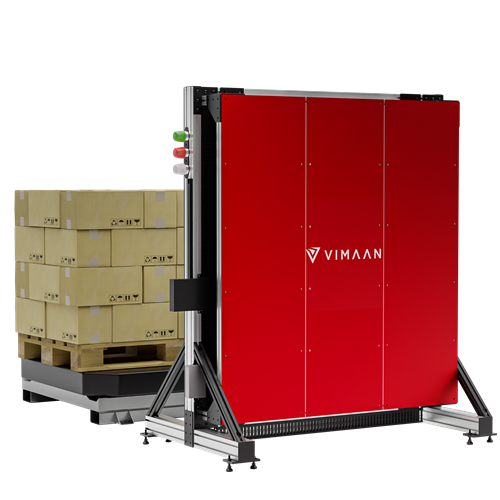
The PalletSCAN family includes drive-by and drive-through scanners that handle whole pallets at speed. For example, PalletSCAN 100-D is mounted at dock doors so forklifts can drive past without stopping. The system uses high-speed cameras and lights to automatically capture all pallet labels and barcodes, count cases, and detect damage. More advanced PalletSCAN units also measure pallet dimensions and compute TiHi (tiers and height) counts, eliminating manual tape measurements.
In practice, PalletSCAN ensures that every incoming or outgoing pallet is identified and validated in real time – flagging any discrepancies or missing items immediately. Crucially, these pallet scans integrate with the warehouse system so that scanning data is automatically recorded, inventory is updated, and shipments are verified as they happen. By automating pallet capture, PalletSCAN can boost receiving throughput dramatically (improving from one pallet per three minutes to three pallets per minute) while slashing labor and errors.
For package-level shipments, ParcelSCAN is a rugged multi-camera scan station. It is typically installed on conveyor lines or at packing/receiving docks to handle boxes and parcels of all sizes. ParcelSCAN scans, tracks, and inspects high-volume packages by reading multiple label sides and extracting every relevant detail. In a single pass, it automates 1D/2D barcode scans and OCR of printed text for UPS, FedEx, and other carrier labels. The system also measures package dimensions and inspects for damage or irregularities, providing instant alerts for issues.
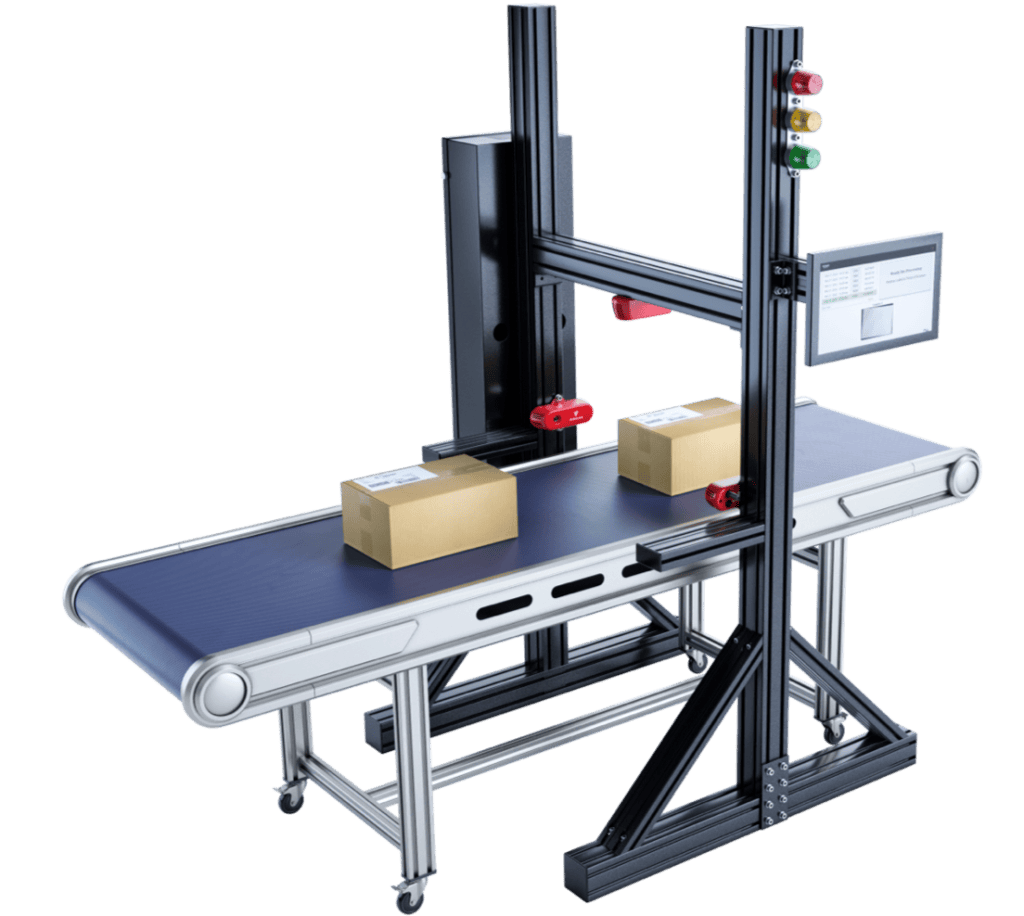
As a result, ParcelSCAN delivers a level of accuracy over 99.8% while drastically lowering manual labor. All scanned data – part numbers, destination, quantities, expiration dates, and more – are forwarded to the WMS in real time. In essence, ParcelSCAN replaces slow hand scans with continuous, automated label capture and validation, ensuring that inbound and outbound parcels always match their system records.
StorTRACK brings automation to rack-level inventory scanning. This system consists of a mobile camera and sensor frame mounted on the warehouse’s existing material handling equipment. As a forklift operator drives down aisles, StorTRACK’s computer-vision cameras rapidly scan pallets and cases on every shelf from floor to ceiling.
The captured images are then processed by AI: barcodes and label data (part numbers, expiration dates, etc.) are read, item quantities are inferred, and bin contents are cross-checked against the WMS. If anything is amiss – a missing pallet label, a misplaced SKU, or damaged packaging – StorTRACK flags it immediately. In practical terms, a single StorTRACK unit can audit a 300-foot aisle in minutes, turning what used to be days of manual counting into a fully visual audit. It even archives aisle images so managers can review condition and placement history.

By taking cycle counting out of the hands of operators and putting it on autopilot, StorTRACK dramatically improves perpetual inventory accuracy while freeing up staff for value-added tasks.
Modern warehouse scanning systems don’t operate in isolation. Every scan event is fed into the warehouse management or ERP system in real time, ensuring the system of record always reflects the actual state of inventory and shipments. PalletSCAN, ParcelSCAN, and StorTRACK all integrate seamlessly with WMS platforms, automatically validating receipts and shipments as they occur.
Inbound pallets or packages are instantly received into inventory upon scan, and outbound loads are automatically verified against orders. This connected workflow enables powerful exception management: if a forklift drives by with a mislabeled pallet or a wrong item is picked, the software immediately generates an alert. Similarly, if StorTRACK detects a count discrepancy on the racks, it flags the issue before it becomes a customer-facing problem. In practical terms, this means live inventory accuracy and shipment verification.
Advanced warehouse scanning systems unlock a host of tangible benefits:
Improved Supply Chain Visibility: Because data is captured digitally at every step, warehouse scanning systems underpin end-to-end visibility. Stakeholders benefit from a single source of truth, complete with photographic audit trails. This transparency streamlines audits and improves planning and forecasting accuracy.
Faster Throughput: Automation accelerates receiving and shipping. Pallet scanning throughput can triple, and ParcelSCAN stations can process packages up to three times faster than manual scans.
Reduced Labor: Much of the data-entry work falls to machines. Tasks that once required dozens of personnel scanning barcodes or writing counts can now be handled by a single system. Freed staff can focus on value-added activities like exception handling or customer service.
Higher Inventory Accuracy: Automated scans are inherently more reliable than human entries. By reading every barcode and label attribute, systems eliminate common errors like mis-picks or missed packages. ParcelSCAN, for example, achieves over 99.8% tracking accuracy, while StorTRACK routinely delivers greater than 99% inventory accuracy.
Fewer Chargebacks and Penalties: With instant verification at loading docks, scanning systems catch errors before shipments leave. This reduces costly chargebacks, write-offs, and on-time penalties, while improving OTIF performance.
Improved Supply Chain Visibility: Because data is captured digitally at every step, warehouse scanning systems underpin end-to-end visibility. Stakeholders benefit from a single source of truth, complete with photographic audit trails. This transparency streamlines audits and improves planning and forecasting accuracy.
Warehouse scanning systems have evolved well beyond mere barcode guns or RFID portals. Today’s leaders view them as foundational to warehouse digitization and supply chain visibility. By automating data capture at every inbound, storage, and outbound touchpoint, these systems eliminate silos and manual bottlenecks.
In practice, an integrated suite of scanning solutions (such as Vimaan’s PalletSCAN, ParcelSCAN, and StorTRACK) can turn a warehouse into a smart, self-auditing operation. The result is faster throughput, more accurate inventory, and seamless data for both warehouse management and enterprise planning systems. For supply chain executives, investing in next-generation warehouse scanning systems is no longer optional – it’s essential to competing on accuracy, cost, and customer service in modern logistics.