

warehouse insider
A warehouse scanning system is essential for streamlining operations. Each workflow—such as receiving, inventory control, or shipping—requires scanning equipment tailored to specific tasks, and every facility comes with its own unique operational demands.
Using the right warehouse scanning system can help maximize throughput, boost productivity, and improve accuracy across your distribution center.

While rugged handheld barcode scanners have long supported data capture in tough warehouse environments, many facilities are now turning to AI-powered alternatives to automate scanning and improve reliability.
Warehouse scanning systems support a range of workflows, including receiving, put away, picking, storage, and shipping, delivering real-time visibility and greater accuracy at every point of transaction.
Inventory receiving is one of the most critical processes in any warehouse or distribution center. The accuracy of this phase impacts every subsequent workflow, which makes accurate data capture during receiving essential to avoid downstream errors. To support this, facilities need a warehouse scanning system that connects in real time, handles high-volume throughput, and can still capture data from labels that may be damaged or hard to read.
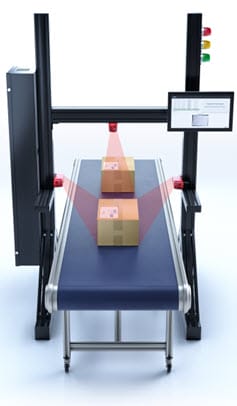
While handheld scanners and wearable devices have been the traditional tools for this task, many operations are now adopting AI warehouse scanning systems for a better outcome. Unlike traditional scanners, AI warehouse scanning systems capture label data, parcel dimensions, and high-resolution images automatically as shipments arrive. It not only verifies barcode data but also detects damage and discrepancies instantly, eliminating errors that traditional warehouse scanning equipment makes during the receiving process.
AI warehouse scanning systems are optimized for high-throughput docks. The hands-free automation can improve both speed and accuracy, even in environments with heavy volume.
Accurate putaway and replenishment are critical in any warehouse distribution center. The placement of a pallet influences everything that follows—picking, inventory counts, and even outbound shipping—so verifying each transaction is essential. A warehouse scanning system can ensure accuracy by quickly capturing and confirming data before items are moved into storage.
Historically, rugged handheld scanners and mobile computers have been used to scan rack location labels and validate pallet information. These devices must be built for tough environments—handling temperature extremes, rapid scanning speeds, and vibrations from forklifts.
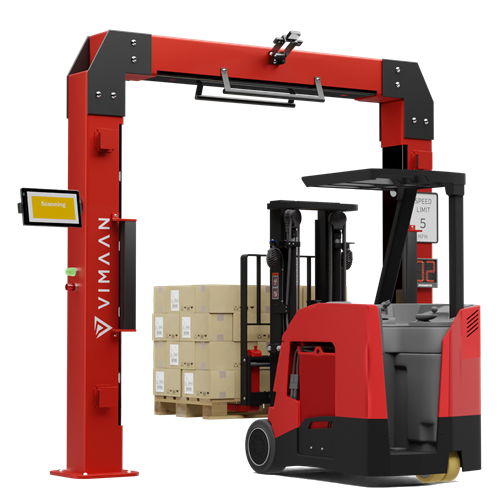
To enhance this process, a facility can deploy a fixed-position warehouse scanning system that is installed at dock doors or staging areas. Workers manually push pallets through the scan zone, where the system automatically captures pallet dimensions, high-resolution images, and barcode data, removing the need for tape measures and manual scans. Cutting-edge warehouse scanning systems can also perform visual inspections for label damage or packaging issues, ensuring clean, validated data before storage.
AI warehouse scanning systems can even operate in cold storage facilities. Their rugged design and hands-free operation make it easy to streamline putaway and reduce costly errors across the board.

Picking is one of the most labor-intensive and error-prone processes in warehouses and distribution centers. As speed and accuracy become more critical, facilities need a warehouse scanning system that minimizes manual inefficiencies and reduces the likelihood of mis–picks.
While wearable warehouse scanning equipment and mobile devices are still commonly used, they rely heavily on human input and can introduce delays or errors, especially in fast-moving environments. Their effectiveness depends on operator consistency, battery life, and physical durability, making them increasingly difficult to scale with high-volume demands.
AI-powered systems improve this by verifying inventory accuracy before the picking stage begins. For example, an AI scanner can validate that pallets are correctly labeled and stored in the right rack location. This pre-validation ensures pickers retrieve the correct items, significantly reducing mis-picks and manual double-checking.
By shifting inventory validation upstream, warehouses can maintain speed while significantly lowering the risk of human error.
Packing and pallet-building areas must operate with speed and precision to ensure orders are shipped accurately and on time.
To improve outbound accuracy and efficiency, facilities can again turn to AI to simplify the process. An AI warehouse scanning system automatically captures barcode data and high-resolution images of outbound parcels, ensuring label accuracy and proper documentation.
For palletized shipments, a reliable AI scanner can do a complete 360-degree scan, verify pallet labels, detect damaged packaging, identify missing or broken shrink wrap, and capture a comprehensive visual audit trail.
This level of verification is especially important in highly regulated industries like alcohol distribution, where label accuracy, condition integrity, and traceability are critical for compliance, legal accountability, and customer satisfaction. With automated scanning in place, warehouses can reduce chargebacks, avoid shipment rejections, and confidently meet industry-specific shipping standards.
Inventory control is a critical component of warehouse distribution center operations. The accuracy of inventory levels affects every downstream process, making it essential to rely on a warehouse scanning system that enables fast, real-time validation, without the delays and errors common to manual paper counts or spreadsheet-based audits.
Historically, handheld scanners and mobile computers have been used for inventory control. While functional, these tools require time-consuming walkthroughs, manual barcode scans, and often introduce human error, especially during large-scale cycle counts.
To streamline this process, facilities are now adopting solutions that are mounted on material handling equipment such as forklifts or reach trucks. A 300-foot aisle can be scanned in under 30 minutes, cutting labor requirements and achieving 99 %+ inventory accuracy.
What once took hours or days is now a seamless, visual audit—completed without operational downtime.
Our team brings a decade of experience in warehouse automation and intelligent data capture. Rather than relying on legacy handhelds or wearable scanners, we offer a full suite of AI-powered warehouse scanning systems designed to meet the evolving needs of modern distribution environments.
From receiving and putaway to inventory control and outbound verification, our solutions are tailored to fit your workflows. The PalletSCAN Suite offers multiple configurations for scanning full pallets at different operational stages, while ParcelSCAN handles parcel-level shipments, and StorTRACK provides continuous visibility across storage locations. Each system integrates seamlessly with your WMS and material handling equipment to improve accuracy, reduce labor, and accelerate warehouse performance.
We work closely with your team to recommend the right configuration based on your goals, delivering clear, strategic outcomes without bias toward legacy hardware