Vimaan at MODEX 2026 – Experience the Evolution (Booth A4109)
Warehouses are capturing all 4 sides of pallets faster than ever before with PalletSCAN 360.

This introductory primer is provided to explain how warehouse drones are used and operate in warehouses and distribution centers. Consider this a crash course in features, benefits and even challenges of deploying drones in the warehouse. As one of the original pioneers of using drones in the warehouse, contributors to this primer include warehouse processionals and aeronautic engineers who have spent thousands of hours flying warehouse drones and have collected enough data to provide an unbiased assessement and overview of this supply chain technology.

Warehouse drones are used to help enhance cycle counting activities in the warehouse. Inventory accuracy is a critical component to managing a warehouse, and historically is very labor intensive. As fulfillment demands have increased, warehouses are forced to carry large amounts of inventory. Unfortunately, warehouses have limited footprints and instead of spreading out their operation, they have embraced high vertical storage shelves for their inventory. While this helps solve the storage challenges, this has impacted the ability for warehouse workers to appropriately cycle count inventory which entails scanning stored goods. This was a driving factor to introducing warehouse drones as a means of scanning both high and low locations of stored goods.
To maintain the richness, comprehensiveness and other advantages of Vimaan’s cycle counting approach, and to eliminate the downsides of using drones to accomplish this goal, Vimaan has engineered StorTRACK, an even more affordable, safer, and faster solution than any other product on the market.
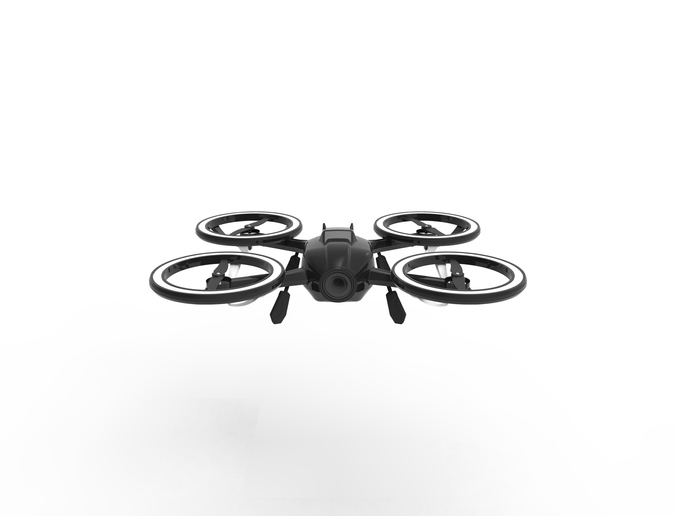
Warehouse drones are capable of reach the highest stored goods in the warehouse, keeping employees safe on the ground. But be careful, if a drone falls from heights over 30 feet and was to land on an employee this could lead to serious injuries. At best, regardless of the technology provider warehouse drones cannot sustain flights longer than 20 minutes due to battery life limitations. Once depleted, batteries are typically swapped out by warehouse workers. This manual activity reduces the “autonomous” promises of warehouse drones. Suppliers will suggest deploying multiple warehouse drones to ensure constant scanning. Managing multiple warehouse drones requires training and additional headcount.
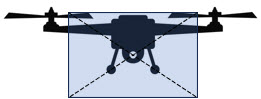
Warehouse drones are an advancement over hand scanning performed by workers (especially for higher shelves, which typically require scissor lifts). A warehouse drone can scan a 300-foot-long warehouse aisle in just over 5 hours. However, this time does not include the stoppages required for warehouse drones to be charged every 20 minutes. Equipped with their own onboard camera and lights, warehouse drones are typically used to scan one large LPN found on a pallet or large box stored on a warehouse rack. Because of weight limitations, a warehouse drone will only carry a single camera, which provides a limited field of view (typically no more than 12 inches). The small field of views will require warehouse drones to slowly fly and hover in front of inventory to ensure the barcodes are capture. Warehouse drones are an advancement over hand scanning performed by workers (especially for higher shelves, which typically require scissor lifts). A warehouse drone can scan a 300 foot long warehouse aisle in just over 5 hours. However, this time does not include the stoppages required for warehouse drones to be charged every 20 minutes.

To prevent injury to workers and damage to the warehouse drone, associates are required to clear aisles of fellow employees and equipment. As mentioned, warehouse drones are required to hover in place to adequately capture barcodes with their small field of views, this hovering creates drafts that inhale loose warehouse material (like shrink wrap or packing tape) into the drone rotors. See an example of this here. When this happens the warehouse drone will continue to try and break free of the material until its battery dies or a warehouse worker goes up to retrieve it.
The benefits and challenges of using warehouse drones are typically discovered after a month of use. Be cautious of committing to long term agreements without truly understanding how warehouse drones will interact with your specific warehouse environment. Solution providers should offer a limited time trial of the technology prior to committing multi-month or year contracts. Warehouses that continue to use the drone technology discover that it will likely improve cycle counting speeds and potentially reduce specific headcount. While the expectation is that warehouse drones will help reduce the number of employees, there are additional responsibilities and new duties that come with operating this technology. So in most instances the warehouse workers will still need to remain on hand to change batteries, clean shelves, clear aisles and keep an eye of the warehouse drones.
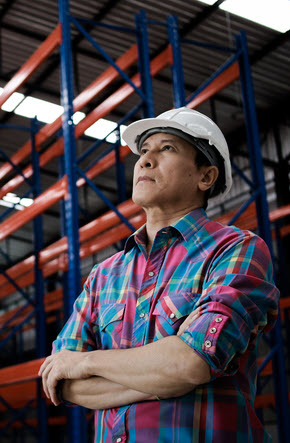

Warehouses understand that automating cycle counting is an essential step in improving their inventory management. Warehouses that have experience with warehouse drones have discovered a safer and faster cycle counting auomation solution with the Vimaan StorTRACK. This computer vision solution includes a field of view 4X larger and a battery life of up to 8 hours, compared to 20 minutes for drones. Warehouse drones are intriguing and can serve as a demonstration of how warehouses are embracing innovation, if they are looking for ways to improve results and reduce headcount, they will discover there are better options, such as StorTRACK.
This all-inclusive automation resource kit includes:
– Cycle Count Automation Demo Videos
– Real-world case study results
– Comprehensive automation guide
– Technology benchmark videos
– Product data sheets and specifications
– Sarbanes-Oxley compliancy technical note
– And more!
Warehouses are capturing all 4 sides of pallets faster than ever before with PalletSCAN 360.
Fast scanning and validation of incoming and outgoing packages with ParcelSCAN
Warehouses are capturing all 4 sides of pallets faster than ever before with PalletSCAN 360.

warehouse insider
By KG Ganapathi and Craig Dowley
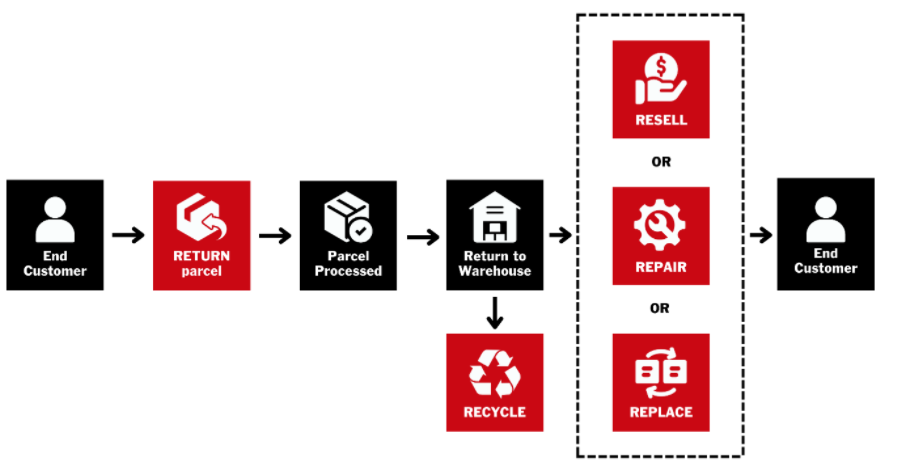
Reverse logistics is the opposite flow of the supply chain, which entails goods moving from customers back to retailers, warehouses, and distribution centers. Like forward logistics, the supply chain network is utilized to recapture some form of financial value before the product value is depleted.
Managing customer returns can be even more costly than forward logistics forcing companies to modify their ways of doing business:
Handling customer returns is simply a part of doing business for retailers but return trends have created strains on warehouses and distribution centers across the retail industry. According to the Retail Federation, brick-and-mortar stores on average experience a customer return rate of 7-10%, which has been viably supported by their logistics operations. However, for orders that are placed online, return rates can be more than 20%! During the 2022 holiday season, retailers expect a combined return rate of 17.9%.
Returns in the B2B space, where items are shipped from a Distribution Center (DC) to a retailer or another business are not as high as the B2C or e-commerce space, but they are a significant problem, nonetheless. DCs frequently experience “chargebacks” or other forms of reverse logistics. The desire to maintain a strong customer relationship, combined with lack of traceability on customer claims makes it difficult for the warehouse operator to reliably implement methods to reduce returns. Sometimes, returns have an even higher cost: The pallets may have the wrong address label, which may send them to the wrong location or to a country that is under ITAR or other government restrictions. Often, if the claims involve food or pharmaceutical or other perishable items, they need to be destroyed rather than shipped back.
Reverse Logistics Case Study 1: eCommerce Fulfilment
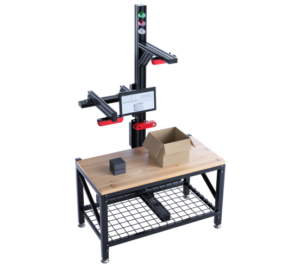
PackVIEW is a system of cameras and sensors installed at the pack station and designed to fit into existing outgoing packing workflows. The cameras and sensors are designed to read the labels on the outside of the packing box, scan and capture each item during packing and then also capture the contents of the packing box as it is being packed layer by layer.
First, the packing box itself is automatically scanned to ensure it has the right order number and the shipping labels on it. Next, all items to fulfill the order are read and captured as they are being packed into the box, ensuring that order packers include the correct SKUs and quantities prior to shipping. All items in the order are digitally captured when inside the packing box in an archive to support future customer dispute resolutions.
After implementing PackVIEW, a Vimaan customer has seen a 70% reduction in complaints. Much of the complaint reduction was enabled because quality issues were caught before the box was shipped to the customer. The archival data was also used for retraining of packing associates, and over time the quality issues caught during packing decreased as well as the associates followed better packing processes. Moreover, time spent on resolving complaints decreased by 50% per complaint, since claims processing associates were easily able to retrieve images to demonstrate compliance.
Reverse Logistics Case Study 2: Manufacturing Uptime
A Vimaan customer runs a DC that contains components and sub-systems that are used to feed a manufacturing line in Just-In Time mode. Orders from the manufacturing line come in every day; they are fulfilled by picking cases to build pallets, and the pallets are trucked from outbound shipping. Frequent errors in the case quantities or LPNs were causing the wrong parts to reach the manufacturing line, resulting in line stoppages.
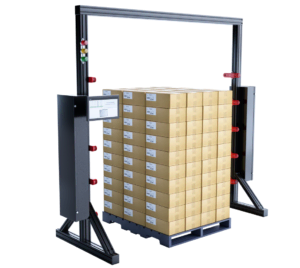
Vimaan implemented its DockTRACK Pallet solution at the outbound pallet staging lane, just prior to truck loading. DockTRACK Pallet automatically scans the case labels, from all five visible sides (all case labels were outwardly visible as part of the natural workflow.) No changes to the workflow are required; the pallet naturally moves at its normal speed through the gate, and the information is captured by the sensors and cameras. DockTRACK Pallet also connects directly to the customer’s WMS and validates the case LPNs and quantities against each master pallet LPN. In the event of any discrepancy, an operator UI highlights the errors so that the pallet contents can be corrected immediately.
Using DockTRACK Pallet, the customer has seen an immediate reduction in erroneous shipments.
These are just two examples of how Vimaan enabled solutions ensure that outgoing orders match manifests and are 100% correct before being fulfilled. All Vimaan solutions capture and digitally store each read, providing digital PROOF every step of the way including pick, pack and shipping validation. Reduce the pain of reverse logistics with proven computer vision solutions that scan, inspect and track customer returns throughout your warehouses, and ensure that your WMS receives the most up to date and accurate data from within your four walls.
All VIMAAN solutions transmit scanned inventory data to the ViewDECK web application for inventory visualization and near real-time analysis. ViewDECK is an intuitive tool that allows you to easily search inventory status and any storage location in your warehouse. ViewDECK generates easy to use inventory reports with actionable data for your entire warehouse team. All ViewDECK data is automatically transmitted to your WMS; ensuring you have the most up to date view of your inventory.
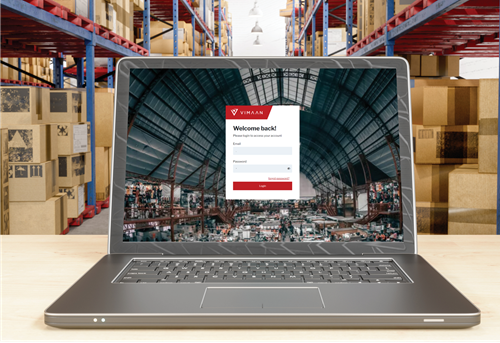
Accessible from anywhere, ViewDECK delivers near real-time updates and analytics straight from your warehouse floor. Regardless of the Vimaan solution, DockTRACK, StorTRACK, PickTRACK and PackVIEW all transmit data and images to ViewDECK. The web-based application is configure-able by customer/account and is accessible from your desk, home, car, and even your phone. Alerts are easily set up within ViewDECK providing you with instant notifications of discrepancies before they can become a future problem to resolve.
Features of the ViewDECK web application are designed to provide our customers with near real-time data that enable them to address discrepancies quickly and efficiently. This easy-to-use inventory visualization program is highly configurable and allows for customized alerts and even saved views of specific inventory data. All images captured by Vimaan sensors can be found in ViewDECK, allowing users to zoom, save and share scans with other users inside and outside the application. Standard ViewDECK inventory visualization reports include:
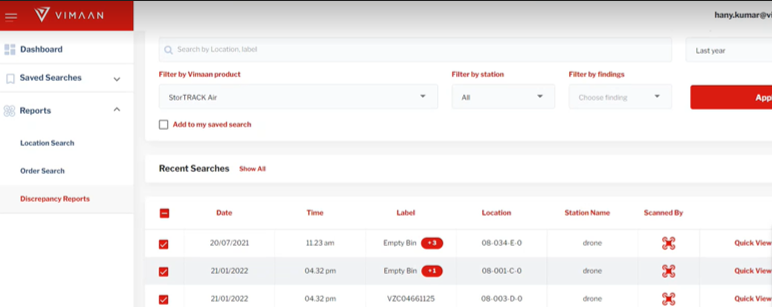


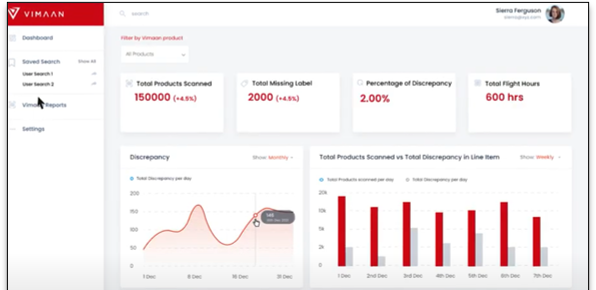


Inventory accuracy is a challenge in almost every warehouse we walk into, and the reasons behind the inaccuracies vary. Understanding the truth behind your inventory involves not just cycle counting of stored inventory but also inventory visualization and reporting. ViewDECK enables warehouse teams to tracking inventory movement and reconciling against your WMS.
Warehouses are capturing all 4 sides of pallets faster than ever before with PalletSCAN 360.
Fast scanning and validation of incoming and outgoing packages with ParcelSCAN
Warehouses are capturing all 4 sides of pallets faster than ever before with PalletSCAN 360.
Successful fulfillment customer orders is the goal of any 3PL, warehouse or distribution center; fast and impeccable order picking is essential to reaching it. While the practice of order picking sounds rather simple, it represents a very big portion of operational costs. When customers receive the wrong items in their order, it results in warehouses managing returns, fulfilling a new order, and handling dissatisfied customers. Suffice it to say, if a facility does not have a flawless order picking process, they will lose money on every wrong order.

No matter the order picking process whether it be discrete order picking, zone, batch, cluster or others having flawless documentation as to where inventory is stored is key every picker’s mission. 3PLs and warehouses commonly express their top order picking challenges include:
Operating a WMS (warehouse management system) is an excellent start to support more effective inventory management and order picking, but this software is only as effective as the data it receives from the receiving, put away, storage and auditing processes. If the WMS contains dated, incomplete or incorrect. Vimaan has worked closely with leading 3PLs and Brands to understand their order picking challenges and has engineered solutions that betters inventory location, speed order fulfillment, improve picking productivity and reduce labor associated with order picking. These improvements have also been instrumental in reducing picking headcount and lowering operational costs; while improving the speed and accuracy of order fulfillment.
Order Picking Item Validation
Inventory Photo Archive
Inventory Location Accuracy
Order Picking Manifest Verification
Label Text Reading
Package Damage Detection
Warehouse Space Utilization
Parcel and Package Scanning
1D/2D Barcode Reading
Inventory accuracy is a challenge in almost every warehouse we walk into, and the reasons behind the inaccuracies vary. Understanding the truth behind your inventory involves not just cycle counting of stored inventory but also accurate tracking of inventory movement and reconciling it in near real time against your WMS.
Computer vision improves your visibility to your inventory while reducing labor requirements
Complete package processing including barcode scanning, text reading, auto-dimensioning and WMS validation
Fast scanning and validation of incoming and outgoing packages with ParcelSCAN
Real-time each verification and validation ensure the highest accuracy in order fulfillment
Ground level inventory capture and tracking, ideal for busy eCommerce operations.