
If you're a warehouse or DC leader responsible for inventory accuracy, the list below will look familiar. Some of these are problems you're fighting every day; others are things you've accepted as too hard to solve with manual counting or the automated options available: drones that need battery swaps every 15-20 minutes and can't operate in VNAs or read through shrink wrap, or ground robots that still only read barcodes. Find the ones that apply to you, then read on to see how Vimaan solves all of them with a single product, StorTRACK, an autonomous cycle counting robot using AI and computer vision to understand and reconstruct inventory, not just scan barcodes.
StorTRACK flows results to your WMS in near-real time. Run a cycle count at 5-20X the efficiency of a manual cycle count every 24 hours and start every shift with accurate inventory records, instead of discovering discrepancies at the pick face. For further details, see: WMS Integration Guide for StorTRACK
| Criteria | Standard Cycle Counting | AI & Computer Vision-powered Cycle Counting (StorTRACK) |
| Inventory accuracy | 95–98% with manual counting; 99%+ with drones or barcode-only robots | Enables 100% accuracy: 99.8% delivered by StorTRACK, with the remaining 0.2% flagged for human reconciliation |
| What it captures | Barcode confirmation: inventory is present at a location | Full inventory reconstruction and intelligence: what it is, how much, its condition, whether it is in the right place, and its date fields |
| Partial pallets | Count goes stale the moment a picker pulls cases; no automatic update | 3D depth map calculates remaining cases in the same pass, no manual recount |
| Missing or damaged labels | Location skipped; gap goes unrecorded | OCR reads label text as fallback; location flagged for follow-up if still unresolvable |
| Shrink wrap | Labels unreadable; location skipped or estimated | Specialized optics and computer vision reads through clear shrink wrap even in the presence of glare |
| Damage | Not detected; damaged goods reach the pick face | Identified and photographically documented in the same pass as the count |
| FIFO / FEFO | Requires a separate audit process | Expiry and lot dates read directly from shelf labels during the count |
| High-bay and VNA coverage | Skipped or counted infrequently; requires a lift for high-bay, inaccessible for drones in VNA | Full floor-to-ceiling coverage in one pass; operates in VNAs where drones and many robots cannot |
| High-density storage | Tightly packed cases and small labels get skipped or undercounted; manual counting is too slow to be consistent | Smart cameras capture every label in dense storage configurations in a single pass, no special preparation required |
| Multi-facility coverage | Each facility requires its own dedicated solution, infrastructure, and setup | One unit moves between sites on a rotating schedule with no reinstallation or reconfiguration |
Q. What is automated cycle counting?
Automated cycle counting replaces manual barcode scanning with a drone or robot that travels warehouse aisles and captures inventory data without a dedicated counting team. StorTRACK goes further than barcode-only automated systems: it reconstructs inventory using AI and computer vision, capturing case counts on partial pallets, reading through shrink wrap, detecting damage, and reading label text; all in a single pass, without shutting down operations.
Q. How often should a warehouse run cycle counts?
The answer depends on your inventory velocity, accuracy requirements, and regulatory obligations. Most operations running manual counts complete one full facility cycle every 30–90 days, long enough for significant errors to compound before they surface. StorTRACK makes daily or even shift-by-shift counting operationally and economically viable, which is what enables 100% inventory accuracy rather than catching errors weeks after they occur.
Q. Can automated cycle counting run without shutting down warehouse operations?
Yes. StorTRACK runs alongside normal warehouse operations without requiring aisle clearance, shift shutdowns, or dedicated counting windows. The fully autonomous version runs lights-out overnight; the semi-autonomous version operates during low-traffic periods with a single operator. Either way, your team is not taken off other tasks to manage the count.
Q. What is lights-out cycle counting?
Lights-out cycle counting refers to fully autonomous inventory missions that run during off-shift hours with no operator involvement. StorTRACK’s fully autonomous version navigates designated aisles, scans every rack face floor to ceiling, and delivers a discrepancy report to ViewDECK before the next shift begins. Your team arrives to findings, not a task.
Q. How does StorTRACK handle cycle counting in high-bay racks and very narrow aisles?
These are the two locations most cycle counting programs treat as acceptable gaps. StorTRACK’s camera mast rises from floor to the highest rack position in a single pass, no lift required for high-bay positions. Its form factor operates in very narrow aisles where drones cannot fly and many robots will not fit. Both are covered in the same mission as the rest of the facility.
Q. How does automated cycle counting integrate with a WMS?
StorTRACK flows scan results to your WMS in near-real time as counting happens, not in a batch at end of shift. Discrepancies are surfaced in ViewDECK, Vimaan’s inventory visualization platform, with supporting images. Your team reconciles records directly in ViewDECK, and the corrected data flows back to your WMS without a manual processing step. StorTRACK integrates with all major WMS platforms. For more details, see: WMS Integration Guide for StorTRACK.
Q. Can StorTRACK count cases on partial pallets during a cycle count?
Yes, and this is one of the most significant gaps in every barcode-only cycle counting system, manual or automated. The moment a picker pulls cases from a pallet, the WMS count is wrong and a barcode confirms nothing about what remains. StorTRACK builds a 3D depth map of every pallet face and calculates remaining cases automatically. For more details, see: How StorTRACK Automates Partial Pallet Counting.
Q. What inventory accuracy can automated cycle counting achieve?
Manual cycle counting typically delivers 95–98% inventory accuracy. Barcode-only automated systems, drones and existing ground robots, reach 99-99.5% by increasing count frequency, but still miss partial pallet quantities, misplacements that have a barcode in the right location, and anything behind shrink wrap. StorTRACK enables 100% inventory accuracy: 99.8% delivered autonomously, with the remaining 0.2% flagged with photographic evidence for your team to review and close the gap. For more details, see: How StorTRACK Enables 100% Inventory Accuracy.
Q. Is automated cycle counting suitable for smaller facilities or lower count frequency?
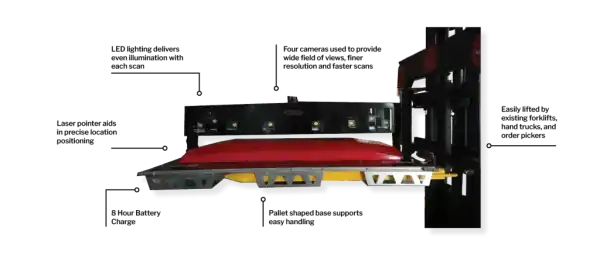
Yes. StorTRACK does not require daily runs or a large facility to deliver value. Smaller operations running weekly or monthly counts can complete a full facility scan in a single mission and surface discrepancies before they compound. The semi-autonomous version runs on existing forklifts with one operator, no new vehicle infrastructure required. For operations with multiple nearby sites, one unit can rotate between them on a schedule, making shared deployment economically viable.