

warehouse insider
Every parcel that moves through a warehouse or distribution center carries risk. A dented box at receiving could mean a damaged product, a supplier dispute, or a customer complaint three weeks later. A parcel leaving the shipping dock without the correct hazmat label could trigger a compliance failure or real-world safety issue. A torn outer carton that passes through undetected becomes a chargeback after delivery.
Manual inspection catches some of these but misses more than most operations realize, particularly at volume. This blog covers what parcel inspection actually involves, where traditional machine vision scan tunnels break down, and how computer vision scan tunnels close the gap.
If you’re new to scan tunnels or want the broader picture before diving into inspection specifics, see: What Is a Scan Tunnel, and How to Know If You Need One?
Most warehouses and DCs use “parcel inspection” as a broader umbrella, one that can stretch from damage detection and label or documentation checks to measuring weight and dimensions, and even to checking a parcel’s contents against the order or shipment record. We’ll cover the first two in this blog: damage detection and label and documentation inspection. For weight, dimensioning and the rest, see Automated Parcel & Package Dimensioning, Weight Measurement and Item Counting.
Here’s a quick overview to understand the two and maximize the gains from implementing an automated solution:
Damage detection is the process of identifying physical harm to a parcel: dents, crushing, tears, surface breaks, punctures, and leakage. The goal is to catch goods that have been compromised in transit or handling before they are accepted into inventory, shipped to a customer, or processed as a clean return. A damaged parcel that passes through undetected creates a cost that is almost always larger than the cost of catching it at the dock. Additional research from an inventory team with minimal evidence available adds up fast and often resolves little.
Label and documentation inspection is about verifying that the parcel carries all required labels, stickers, seals, and documentation. This includes confirming the shipping label is present and readable, the correct type of specialized labels are affixed where required, quality control markings are visible, and seals have not been broken. These checks are especially important in regulated industries, where a missing label or incorrect documentation can lead to compliance failures, delays, fines, or rejected shipments.
In a more robust audit process, a parcel can be physically undamaged but still fail inspection because a label is missing or unreadable. Equally, a parcel can carry all the correct labels but still be physically damaged. In many industries, both checks are needed, and treating them as the same problem leaves real exposure unaddressed.
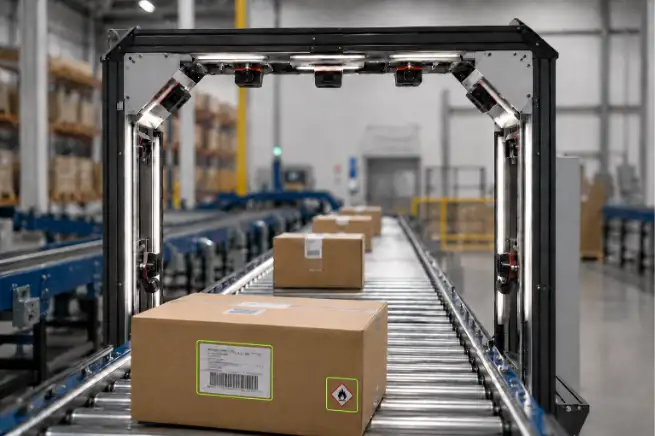
In a manual inspection workflow, an operator visually examines each incoming or outgoing parcel or package. They look for visible damage, check labels, verify seals, and note any discrepancies on a paper or digital checklist before the item is accepted, moved to storage, or loaded for dispatch.
This might work well at low volume when the operator has time to look carefully at each package. It breaks down in the following three predictable ways as volume increases:
1. Speed and Attention
When hundreds or thousands of parcels move through a line every hour, operators do not have time to inspect each one closely. Even experienced ones operate under time pressure and fatigue, which means they cannot carefully inspect every parcel. They might scan the wrong label or skip minor damage and staining or simply overlook the missing labels.
2. No Photographic Record
Manual inspections do not create a photographic record. When a supplier says a parcel left in good condition, or a customer says it arrived damaged, there is no timestamped image to settle it. Resolving the dispute comes down to conflicting accounts rather than documented evidence.
3. Inconsistency across Shifts and Operators
Inspection quality varies between operators and across shifts. What one operator flags in the morning may be missed by another one later in the day, or by the same operator under different conditions. This inconsistency is a structural feature of any human-based inspection process.
The obvious response to the limitations of manual inspection is automation. But the most widely considered solution, a machine vision scan tunnel, cannot fully solve them. These systems work by comparing what they see against a predefined template. On a manufacturing line inspecting identical products, this works well: every item should look the same, the system is trained on what a correct item looks like, and it flags anything that deviates. It is fast, accurate, and reliable because the inputs are consistent.
However, unlike products on a production line, many types of parcel and package handling do not follow a standard format. They arrive in different shapes, sizes, packaging types, and label placements from 3rd party carriers; sometimes vendors change parcel dimensions for a given item without warning. Because of this variation, it is difficult to define what a “normal” parcel looks like. A system that relies on rigid rules and templates will either flag too many harmless differences or miss genuine issues because they fall outside its configured parameters.
This is why legacy rule-based scanning systems and machine vision solutions structurally fail at these two parcel inspection capabilities: damage detection and label/documentation checks. The problem is not a calibration issue or a configuration issue. It is a fundamental mismatch between what the technology was designed to do and what these two capabilities actually need.
A computer vision scan tunnel like Vimaan’s ParcelSCAN handles this differently, it does not rely on a fixed reference image for every parcel. Instead, the system is trained on thousands of real-world parcel images and learns to identify signs that something is wrong, regardless of whether that exact parcel or that exact anomaly has been seen before. A dent is recognized because the surface of the box appears distorted. A tear is identified because the packaging surface shows a structural break. The system interprets what is present in the image rather than comparing it against a template of what should be there.
This allows the system to inspect parcels that might be different from what it has encountered before and catch damage types that vary in appearance from parcel to parcel. Rule-based systems require the anomaly to match a known pattern, while computer vision identifies it from the images itself. As a parcel moves through the scan area, multiple cameras positioned around it capture its faces from different angles, and rather than judging each camera’s frame on its own, ParcelSCAN’s AI and machine learning models combine those images and stitch them together over time as the parcel travels down the line, interpreting the full set of views as a single, complete picture of the parcel. This is what lets it inspect reliably in real time even when any one view is partial, angled, or blocked, flagging damage, label issues, and other anomalies before the parcel moves further through the operation.
ParcelSCAN identifies physical harm to packaging that would either be missed by manual inspection at volume or pass through a rule-based system entirely. The damage categories it covers include:
• Dents and crushing: Deformation to the outer surface of a box indicates the contents may have been compressed or impacted during transit.
• Tears and punctures: Breaks in the packaging surface expose the contents or indicate a structural failure that may affect product integrity.
• Edge breaks and corner damage: Specific weakening of packaging integrity at corners or edges, where transit stress most commonly concentrates.
• Leakage: Visible evidence of liquid or other content escaping from the parcel.
• Staining and water damage: Discoloration that indicates exposure to moisture or contaminants during transit.
Each flagged parcel is archived with a timestamped image in Vimaan’s ViewDECK platform, creating a visual evidence trail that can be retrieved for supplier disputes, carrier claims, or internal quality reviews without requiring a separate documentation process.
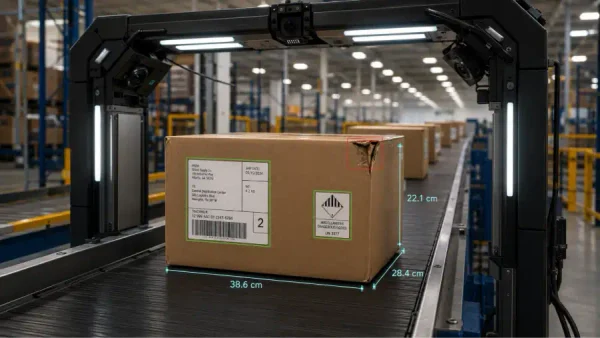
Damage detection is one subset of what computer vision can verify at the dock. The broader inspection requirement covers the following label and documentation checks that are particularly important in regulated or compliance-sensitive operations:
Label Verification
ParcelSCAN reads label content in the same pass as the damage check. It verifies that the correct shipping label is present and readable, that destination and routing information is present and legible, and that any required compliance labels, such as hazmat stickers, QC markings, or temperature-sensitive indicators, are affixed in the correct position.
Seal Integrity
For parcels where seal integrity is a compliance or quality requirement, ParcelSCAN can verify that seals are intact and have not been tampered with or broken during transit.
Documentation Presence
In regulated industries where specific documentation must physically accompany a shipment, ParcelSCAN can confirm that required paperwork or markings are present on the parcel before it is accepted or dispatched.
These capabilities matter most for operations handling hazardous materials, pharmaceutical goods, high-value regulated products, or any shipment where a missing or incorrect label has legal, financial, or safety consequences. The cost of catching a missing hazmat label at the dock is significantly lower than the cost of a compliance failure after dispatch.
Both of these parcel inspection capabilities apply across multiple points in the warehouse or distribution center workflow, not just at a single dock. The value of catching an anomaly is highest the earlier it is identified, which is why computer vision is most effective when deployed at every major handling touchpoint:
Inbound Receiving
At receiving, damage detection determines whether goods accepted from a supplier arrived in the condition they were shipped in. A timestamped image at the point of acceptance is the evidence that resolves supplier disputes. Without it, the operation either absorbs the cost of damage it did not cause or has no basis to prove it did not.
Outbound Shipping
At shipping, parcel inspection ensures that goods leaving the facility are in acceptable condition and correctly labeled before they reach the customer. Catching a damaged parcel or package, or a missing label, at the dock is significantly cheaper than processing a return, a chargeback, or a compliance finding after delivery.
Returns Processing
For operations that handle returns, ParcelSCAN can assess the condition of incoming goods automatically at the returns dock, grading parcels or packages as sellable, damaged, or unsellable without requiring a manual inspection for each one. This is particularly valuable for high-volume e-commerce returns where manual grading creates a bottleneck.
ParcelSCAN deploys across all three of these touchpoints, operating on a conveyor at the receiving or shipping dock and archiving a searchable image of every parcel scanned.
Q. What is the difference between parcel inspection and damage detection?
Most warehouses and DCs use “parcel inspection” as a broader umbrella, one that can stretch from damage detection and label or documentation checks to measuring weight and dimensions, and even to checking a parcel’s contents against the order or shipment record.Damage detection is a specific subset of parcel inspection and focuses on identifying physical harm to packaging: dents, crushing, tears, punctures, and leakage.
Q. Why do machine vision scan tunnels fail at parcel damage detection?
Machine vision scan tunnels work by comparing what they see against a predefined template of what a correct item looks like. This works on manufacturing lines where every item is identical. Parcels have no consistent template: they vary in size, packaging material, label placement, and condition. A machine vision system applied to parcels either generates excessive false positives or misses genuine anomalies. Computer vision solves this by interpreting the scene from the image itself rather than matching against a prior reference
Q. What types of damage can computer vision scan tunnels detect on parcels?
Computer vision scan tunnels like Vimaan’s ParcelSCAN can detect dents, crushing, tears, punctures, surface breaks, corner damage, leakage, and staining. It identifies these anomalies by analyzing surface geometry, texture, and structural integrity from the parcel images rather than by matching against a fixed reference. This allows it to catch damage types that vary in appearance from parcel to parcel.
Q. Can parcel inspection be automated for both receiving and shipping?
Yes, a computer vision scan tunnel like Vimaan’s ParcelSCAN can operate at both the inbound receiving dock and the outbound shipping dock. At receiving, it creates a record of inbound condition for supplier dispute resolution. At shipping, it verifies outbound condition and label accuracy before goods leave the facility. It can also be deployed at the returns dock to automate condition grading for incoming returns.
Q. How does automated parcel inspection create evidence for damage claims?
Every parcel that passes through the scan station is imaged and archived with a timestamp. This creates a searchable photographic record of each parcel’s condition at the exact moment it was scanned. When a supplier claims goods were not damaged when shipped, or customer claims goods arrived damaged, the archived image shows the actual condition at the point of acceptance or dispatch, providing factual evidence for resolving the dispute.