Automated Parcel Receiving, Shipping & Returns with AI & Computer Vision

Stop Stitching Together Tools for Different Parcel & Package Workflows, Automate Everything with One Platform

Parcel and package scanning has to keep pace with volume, shift after shift, and it has to handle far more than a barcode. Across receiving, shipping and returns, every parcel or package crossing your docks needs to be identified, inspected, dimensioned, and matched to an order, without slowing the line. Today, doing all of it usually means stitching together separate solutions (barcode readers, machine vision tunnels, dimensioners) and still working around what none of them can solve. Vimaan’s ParcelSCAN is an AI-powered computer vision scan tunnel that brings Inventory Intelligence to parcel and package scanning, handling all of it on one platform.

LIVE WEBINAR • OCT 14 • 2 PM EST
KG Ganapathi

30+ Years of Scan Tunnels: From Barcode Reading to Parcel Understanding

with KG Ganapathi, CEO, Vimaan

What Parcel and Package Scanning Needs to Automate

If you're a warehouse or DC leader handling parcel strategy and operations across receiving, shipping, and returns, the list below will look familiar. Some of these are problems you're actively trying to fix; others are things you'd like to do but can't, given the limited capabilities of existing solutions in the market: handheld and fixed-mount barcode readers, machine vision scan tunnels, line-scan tunnels, and standalone dimensioning systems. Find the ones that apply to you, then read on to see how Vimaan solves all of them with a single product, ParcelSCAN, a computer vision scan tunnel for parcel and package receiving, shipping and returns.

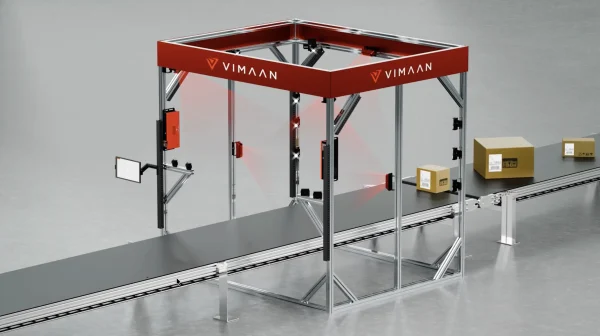
Vimaan ParcelSCAN: Computer Vision Scan Tunnel
ParcelSCAN by Vimaan: Computer Vision Scan Tunnel
Read Every Label, However It Arrives
Applies to: Receiving and Shipping
  • Read 1D and 2D barcodes at any placement, and fall back to OCR and label attributes when a barcode is damaged, partial, or missing.
  • Flag missing, unreadable, wrong, duplicate, or misplaced labels.
  • Read non-standard formats that rule-based systems reject: polybags, mailers, irregular cartons, and mixed packaging.
  • Assess label position to find clear areas for print-and-apply applicators, and apply your own internal handling label at intake. (Receiving)
Applies to: Receiving, Shipping, and Returns
  • Detect visible damages in packages and parcels: crushed corners, tears, holes, dents, open flaps, and poor sealing.
  • Catch wrong carton size, excessive void space, and underfilled or overfilled parcels before shipment. (Shipping)
  • Verify retail, marketplace, or customer-specific packaging requirements were followed. (Shipping)
  • Verify compliance for regulated or sensitive shipments, such as batteries in air freight. (Shipping)
Applies to: Shipping (primary) and Receiving
  • Measure parcel and package dimensions automatically for carrier billing, shipping compliance, and carton optimization.
  • Integrate with your existing inline scale for weight. ParcelSCAN integrates with your scale rather than supplying it.
  • Compare actual dimensions and condition against expected data from upstream systems.
Applies to: Receiving and Shipping
  • Confirm the right items and the right quantity are in each parcel, carton, or tote before it is packed or shipped.
  • Match every parcel to the correct order, shipment, store, customer, or destination. (Shipping)
  • Verify the label, barcode, order ID, and tracking number before dispatch. (Shipping)
  • Reconcile parcels against the PO or ASN inbound, and the order manifest, OMS, or carrier system outbound.
  • Handle high-volume, mixed-SKU parcels and multi-parcel partial orders without relying on manual operator checks.
  • Build and maintain an item master from what is actually captured at the dock. (Receiving)
Applies to: Receiving, Shipping, and Returns
  • Capture a timestamped image of every parcel or package at induction, pack-out, receiving, or returns.
  • Create a searchable audit trail for regulated, fragile, expensive, or customer-sensitive shipments.
  • Settle claims of missing, incorrect, or damaged product with evidence, not argument.
Applies to: Returns, and exception handling across all workflows
  • Inspect returned parcels or packages and document condition at intake for claims, disposition, and resale decisions. (Returns)
  • Route failed parcels to rework, hold, repack, or supervisor review.
  • Reduce manual QC labor at packing, parcel audit, returns, and exception stations.

Applies to: Receiving and Shipping

  • Read 1D and 2D barcodes at any placement, and fall back to OCR and label attributes when a barcode is damaged, partial, or missing.
  • Flag missing, unreadable, wrong, duplicate, or misplaced labels.
  • Read non-standard formats that rule-based systems reject: polybags, mailers, irregular cartons, and mixed packaging.
  • Assess label position to find clear areas for print-and-apply applicators, and apply your own internal handling label at intake. (Receiving)

Applies to: Receiving, Shipping, and Returns

  • Detect visible damage: crushed corners, tears, holes, dents, open flaps, and poor sealing.
  • Catch wrong carton size, excessive void space, and underfilled or overfilled parcels before shipment. (Shipping)
  • Verify retail, marketplace, or customer-specific packaging requirements were followed. (Shipping)
  • Verify compliance for regulated or sensitive shipments, such as batteries in air freight. (Shipping)

Applies to: Shipping (primary) and Receiving

  • Measure parcel dimensions automatically for carrier billing, shipping compliance, and carton optimization.
  • Integrate with your existing inline scale for weight. ParcelSCAN integrates with your scale rather than supplying it.
  • Compare actual dimensions and condition against expected data from upstream systems.

Applies to: Receiving and Shipping

  • Confirm the right items and the right quantity are in each parcel, carton, or tote before it is packed or shipped.
  • Match every parcel to the correct order, shipment, store, customer, or destination. (Shipping)
  • Verify the label, barcode, order ID, and tracking number before dispatch. (Shipping)
  • Reconcile parcels against the PO or ASN inbound, and the order manifest, OMS, or carrier system outbound.
  • Handle high-volume, mixed-SKU parcels and multi-parcel partial orders without relying on manual operator checks.
  • Build and maintain an item master from what is actually captured at the dock. (Receiving)

Applies to: All three: Receiving, Shipping, and Returns

  • Capture a timestamped image of every parcel at induction, pack-out, receiving, or returns.
  • Create a searchable audit trail for regulated, fragile, expensive, or customer-sensitive shipments.
  • Settle claims of missing, incorrect, or damaged product with evidence, not argument.

Applies to: Returns, and exception handling across all workflows

  • Inspect returned parcels and document condition at intake for claims, disposition, and resale decisions. (Returns)
  • Route failed parcels to rework, hold, repack, or supervisor review.
  • Reduce manual QC labor at packing, parcel audit, returns, and exception stations.

Existing Solutions Automate Only Part of What You Need, ParcelSCAN Automates All of It

Capture Reality 1

Capture Reality

Multiple cameras mounted on the scan tunnel capture each parcel from one to all six sides (depending on the customer requirements) as it moves through the tunnel on your conveyor: barcodes, labels, dimensions and condition, in one pass.

Interpret Data 1

Interpret Data

Proprietary AI and computer vision models read every barcode, fall back to OCR and label attributes when a barcode is damaged or unreadable, detect damage and measure dimensions, turning each parcel into structured data.

Get Insights Act 1

Get Insights & Act

Advanced analytics reconcile every parcel against your WMS or order in real time, flag anomalies as they happen, and archive a timestamped image of every parcel in ViewDECK, our visualization platform.

Why existing solutions fall short

Every existing solution in the market for parcel and package scanning was built to do one or a few jobs well, not everything that your parcel operation needs. A barcode reader identifies; it doesn't inspect condition or measure dimensions. A standalone parcel and package dimensioning system measures; it doesn't read a label or catch damage. A machine vision scan tunnel does more, but it runs on fixed rules: it recognizes the parcels and packages it was configured for and rejects everything else as an exception, a torn label, an odd placement, a shape it wasn't trained on. And many machine vision tunnels capture a parcel or package as thin, stitched image strips rather than a complete picture, which is enough to confirm an ID but not enough to reliably catch damage or read a label that isn't perfectly placed. That's why solving all of what you're facing today usually means stitching together two or three separate solutions and still living with problems and capabilities none of them can handle.

How ParcelSCAN solves all of it

Vimaan’s ParcelSCAN replaces that stack with one system, because it runs on AI and computer vision instead of fixed rules or a single dedicated function. It captures each parcel or package as a complete image, identifies it, falls back to OCR and label attributes when a barcode is damaged or missing, inspects for damage and compliance, and measures dimensions, all in the same pass. Because it learns from your real parcels and packages instead of matching against pre-configured cases, it keeps working on the variation that stops a rule-based tunnel: a new carrier label, an unusual placement, a shape it hasn't seen labeled exactly that way before. For weight and RFID, ParcelSCAN integrates with your existing inline scale and RFID readers rather than requiring separate hardware. So everything comes together in one reconciled record, the Inventory Intelligence to act on every parcel and package with confidence, instead of data scattered across multiple systems.
Tell us the parcel and package scanning use cases your current solutions can’t handle, and your volumes across receiving, shipping and returns. We’ll show you how ParcelSCAN can solve them and the ROI of the switch.

Related Resources

FAQs – Automated Parcel Receiving, Shipping & Returns with AI & Computer Vision

Q. What is a computer vision scan tunnel for parcel and package scanning?

It’s a fixed scanning station mounted over your conveyor that captures each parcel or package as a complete image and interprets it with AI & computer vision, rather than matching it against fixed rules. Unlike a barcode reader or a machine vision tunnel, a computer vision scan tunnel can identify a parcel or package, read its labels even when a barcode is damaged, inspect it for damage, and measure its dimensions in a single pass, across receiving, shipping, and returns.

Q. Can one system handle parcel receiving, shipping, and returns?

Yes, though it’s worth understanding how. A scan tunnel is fixed over a conveyor, so each point that needs scanning (receiving, shipping or returns), has its own ParcelSCAN tunnel. What’s shared is everything else: the same computer vision platform, the same integration to your WMS, and the same operational model run at each one.

Q. How is ParcelSCAN different from a machine vision scan tunnel?

A machine vision scan tunnel runs on fixed rules, so it handles the parcels and packages it was configured for and rejects the rest as exceptions. ParcelSCAN uses computer vision that learns from real parcels and packages, so it keeps working on the variation that stops a rule-based system: a new carrier label, an unusual placement, a damaged barcode, or a non-standard format like a polybag or mailer.

Q. Do I need separate tools for scanning, dimensioning, and damage detection?

No, and that is the core difference. Today, covering identification, dimensioning, damage detection, and evidence usually means stitching together separate solutions. ParcelSCAN does all of it in one pass on a single platform, and integrates with your existing inline scale and RFID readers for weight and RFID rather than requiring separate hardware.

Q. Can ParcelSCAN read damaged, missing, or poorly placed labels?

Yes. When a barcode is damaged, partial, or missing, ParcelSCAN falls back to OCR and label attributes to identify the parcel or package, and it reads labels at variable placement and on non-standard formats that rule-based systems reject.

Q. How does ParcelSCAN help with damage claims and disputes?

ParcelSCAN captures a timestamped image of every parcel and package at receiving, shipping or returns, creating a searchable visual evidence trail. When a supplier or customer disputes a shortage or damage, the claim is settled by that record rather than by memory.

Q. Does ParcelSCAN require replacing my WMS or my existing equipment?

No. ParcelSCAN mounts over your existing conveyor and feeds validated data to your WMS or ERP; it does not replace your system of record. It also integrates with your existing inline scale and RFID readers rather than requiring you to replace them.

Q. How many parcels and packages can ParcelSCAN handle, and does it slow the line?

ParcelSCAN is built to keep pace at full conveyor speed, so it verifies every parcel rather than a sample, without becoming the bottleneck. Exact throughput and parcel-size specifications are on the ParcelSCAN product page.